Search This Blog

April 2, 2019

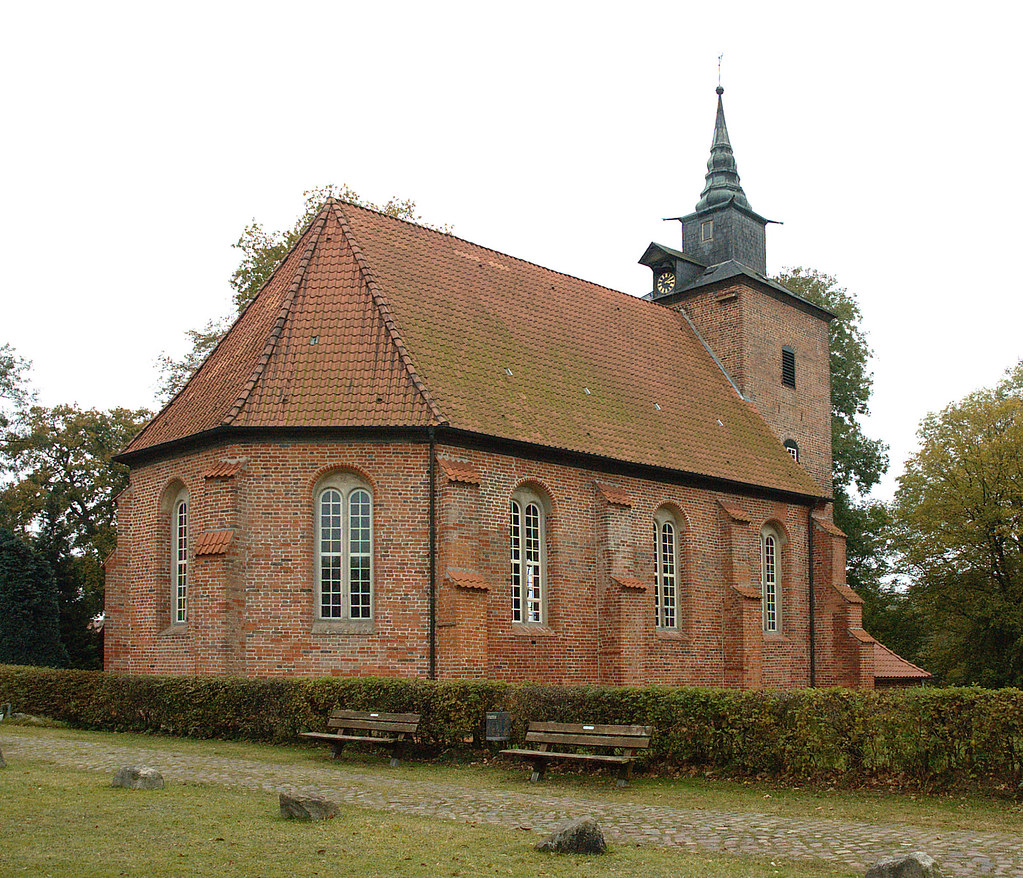
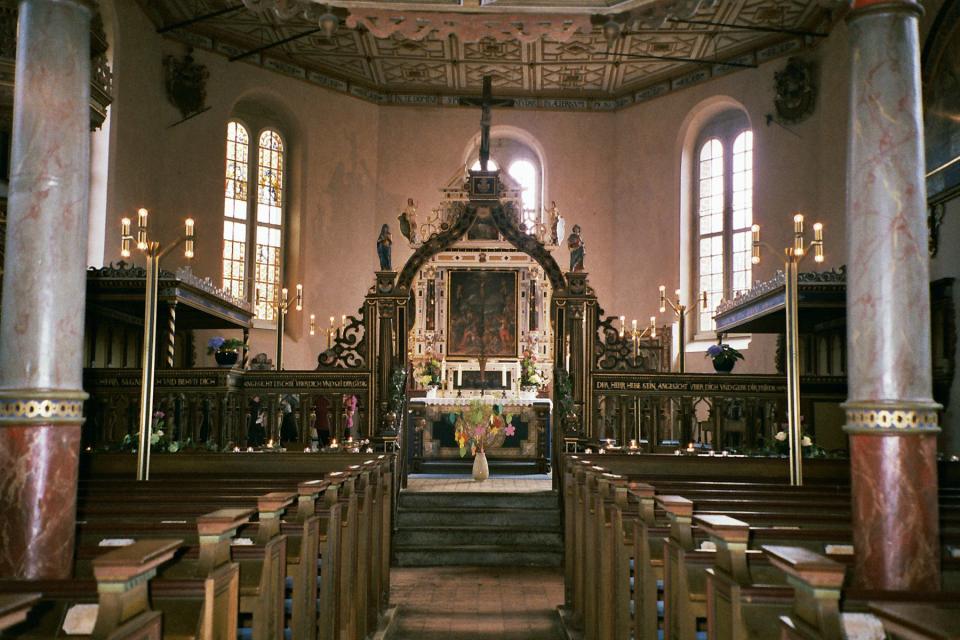
The Church in Stellichte


Thanks to the internet, we can take a look at Stellichte, the village where Heinrich Friedrich Elling (more often called "Fritz" or "Fred" on the records) was born and baptized.

If interested, check out the following websites which, of course, are in German. Just right click on your mouse, choose Page Information toward the bottom of the menu, then Translate This Page. It will be a rough translation, but good enough that you can get the gist of the articles.
 Image result for Stellichte church image


http://www.walsrode-net.de/tourismus/stellichte.html
http://www.stellichte.de/html/sehenswertes.html - nice photos
http://www.kirchenkreis-walsrode.de/pages/gemeinden/walsrode.php - Stellichte is toward the bottom of the page, but click on the Stellichte Church on the menu and you will see much more.

This blog is forcing me to become a LITTLE more organized. With your x-ray vision, you can imagine me at the keyboard, surrounded by boxes, notebooks, stacks of paper (at least one tree worth) and photos. If some of the next blogs seem out of chronological order, it's probably because something was buried, miraculously found and then posted! If you are copying some of the family history, I know that you can put it all in order your way!

I am also moving things from two former blogs into one blog.  The Elling Family News is no more and I am migrating blog posts from A Face to the Sun to my now lone blog, At the Riverbend.  So things will be out of order as I'm putting some new things in, too.   

Image result for Stellichte church image

Back Another Generation - Heinrich Friedrich Elling


The father of Albert Elling, my great grandfather, Heinrich Friedrich Elling (known as Fred), was born in the village of Stellichte, Germany on October 24, 1852.  I am proud of the two documents above that verify this birth and baptism.  .

The birth record - Tauf-Urkunde - states that this record is in the Lutheran Church of Stellichte 1852 church book, page 41, number XV. Family Name - Elling,
Given Name - Heinrich Friedrich, born 24 October 1852 in Stellichte.
Parents - Friedrich Elling, kothne or cottager and his wife Anna Marie Engel born Fuhrhop.
Baptised 28 Nov 1852 in the church in Stellichte
Godparents - Heinrich Friedrich Engelke and Johann Heinrich Rohr (?)
At the bottom of the record is the church seal and repository for the record (Walsrode) and the date it was released to me.

The top image is a copy of the actual baptismal record as it appeared in the church book. Quite a challenge for most of us to read.

Heinrich Friedrich's father, (Johann) Friedrich, my great-great grandfather, was described as a kothner in Stellichte in the above birth record. This was a term for his occupation/social standing. What did it mean to be a kothne/ koetner in the 1850's in northern Germany? Most agree that this means the man had a little house with a stable for one or two cows, pigs, or sheep and perhaps some chickens. Koetners did not have horses, but instead used the cows for farming their small fields. The owner of those fields would have been a nobleman and the koetner was a renter of the field, usually paying 10% (den Zehnten) of his profits as rent. This rent would be paid in grain, brought to a special storehouse. The koetner was also obligated to work for the nobleman in other ways - constructing buildings or roads or cutting wood. It was a humble life. One source called the koetners "free slaves." When our ancestors heard about America, it mus have been very enticing to emigrate to a place where they could own land quite cheaply.

Freedom Township


Grandfather Albert and his siblings were the third generation of Ellings in the United States. Their father had come over as a child with his parents to settle in Freedom Township, Henry County, Ohio. Before we go further back in family history, I thought these excerpts from the History of Henry and Fulton Counties would give a good description of what the township was like when our ancestors came here in 1859.


"Chapter XX - History of Freedom Township
Everywhere we turn we are bewildered by the fire of 1847. Even the record of the civil organization of the townships cannot be found. It is known, however, that Freedom was one of the first of the five townships organized in the territory now composing Henry County; that it, and Napoleon township, in 1840, included nearly, if not all of the said territory north of the Maumee River, together with all of Fulton county, which was organized in 1850. At that time, with all of its territory, it had a population of only one hundred and five... In 1850 it contained four hundred and sixty souls, and the taxable value of the property amounted to $27,602. In 1860 the population...was four hundred and fifty and the valuation $71, 697...

The topography is that in common with the balance of the county, level and the soil exceedingly good and fertile. The township is devoid of waterways, with the exception of three small creeks, the largest being Napoleon Creek and Oberhaus Creek. These traverse the whole width of the township.
The early settlers of this section were few; not more than a score lived in the township prior to 1860..

From 1860 up to the present time there has been an influx of Germans to this county, and especially to Freedom township. To this frugal people may be given a great deal of the credit of converting a wilderness into a garden, for the reason that they were not choice as to the kind of land Uncle Sam gave them, and whether a swamp or ridge, it was the same to them, and they went to work. Now Freedom township is a model of well-kept farms; now there are six school-houses, a couple of churches and scores of brick dwellings." pp. 227-228

This book was published in 1888, Lewis Cass, ed.
Here's the BEST part - the entire text of this book is online at http://www.archive.org/stream/historyofhenryfu00aldr
You can flip through the book and read as you please!

March 31, 2019

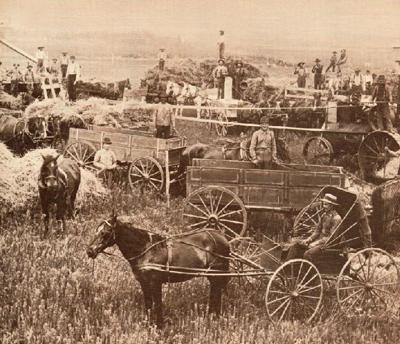
Another Photo From Threshing Day


Aunt Alma Elling Hicksted wrote in her memoirs, " Then came the threshing days.  They were fun for us kids, and I think the women enjoyed themselves, too.  It gave them a chance to get together and bake and cook bountiful meals for their men and families.

There were about twenty families that had the threshing machine and all helped each other.  There were like two groups that lived close together - some ran the threshing machine and separator and lots of the others brought their teams and wagons and did the field work and brought the shocked wheat bundles loaded on wagons to the machine.
 Image result for threshing


There were lots of children and the older ones had to watch the younger ones.  Sometimes they were at one place for dinner and another one for supper.  And what good, big meals they cooked.  And the desserts - especially the pies and cakes.

About 9:30 a.m. was Frustuch or what is now called break time.  Sandwiches and cold water were taken to the men as they had worked long and hard already - usually bologna, summer sausage, and cheese sandwiches.  Then sometimes we had to walk from one place to the next and always several little ones in buggies.  On occasion we were lucky and a farmer would be going with a team of horses and wagon and would help the mothers put the buggies and little ones on his wagon and we would ride to the next place where threshing was to be done.  Even at that, those were such fun days. 

The photo below came from Alma and it is marked as a threshing day photo taken at a farm not far from the Seeman farm.  My father is in the buggy and he was born in September 1923.


Her identifications: "From the left is Paul Elling, Alfred Elling, From the other end is Rudy in buggy.
Next to buggy in front row is Arnold Sunderman (I was confirmed with him) and next smaller one is his brother Raymond Sunderman and next to him is Alma Elling Hicksted, a towhead and the one behind me is Laura Sunderman Grobrogge.  
The others I'm not sure of.  It's been too long, long ago.  I know there were some Meyers, Ludemans and the elderly lady is Minnie Seeman."

March 30, 2019

Letters and Photos from Aunt Alma Elling Hicksted


I've started to spring clean some of the genealogy boxes - a task that is long overdue!  Starting with the Elling box, the first family that really started me on this hobby.  One day, after Dad Rudy had his terminal cancer diagnosis, he and I were at their kitchen table and he started on some family stories.  That led to family talk and who was related. Eventually a notebook and pen had to come out for some notes and there it was...the beginning of creating the family tree.

The aunts and uncles helped, too, in building the trail back to Germany, but Aunt Alma was the consumate letter writer and family historian. Her memory was excellent, and I think I've saved every carefully handwritten note from her. Today I came across one I had forgotten about from 2006.  Included in the bright, yellow envelope was a two page (both sides filled!) letter and several photos that will be shared on the blog.  How could I forget that she had sent these? 


"This was taken on St. Rt. 65 south of West Hope at the Seeman farm.  We were visiting there on a Sunday night many, many years ago.
Front row L to R: Alma Elling, Dorothy Seeman Lange, Rudy Elling, Alfred Elling and Alvin Spoering.
Back row L to R: Elda Benien Arps, Emma Benien Rettig, Alma Seeman Rettig holding Wilma Seeman Lange in her right arm and Lorna Elling in her left arm (as it is facing us) Henry Seeman and Paul Elling"

My tow headed dad with the funny hat!  Al and Paul are looking so grown up with their ties and "big boy" hats.   I'm guessing this might be around 1926 or 1927?  What do you think?  The boys had their knickers on.

Reasons for Coming to America

Image result for immigrant ship image 

From the diary of Philip Jacob Maurer, during the sea voyage to America in 1833 -

"The thought came to me early in the month of October 1832 that I should go to America with my children.  From the moment I resolved to go I became happy and carefree.  It seemed as though that I was transformed.  At work and in marching I was never tired.  I could make a two hour march in one and a half hours.  Thank God for the wonderful gift of health and for a light and happy heart.

The conditions that influenced me to go to America are as follows: 

1. The bad housekeeping of the State where the expenses are so great, and the princely household, the officers and the state officials are paid too high also the customs and the toll.  The land is cut into small parts so no one gets into a new land with each day's journey, and each land is encircled by a toll line.  Commerce is hindered.  The last cent is taken away from the common people.  Also the money must be changed and the people are again the losers.

2. Of complimenting and politeness and saluting there is no end.  One hardly knows how to frame his sentences so as not to offend.  Everyone wants to be addressed as THOU.

3 In the field and in the home one is robbed.  One cannot be careful enough.

4 Poverty is so universal that one has to hand out 10-15 pounds of bread daily.  Among these are many beggars.  One knows them but dares not to refuse them, because of what they may do.  They live in the next village and are very dangerous.

5. One cannot be too careful in the lending of money and grain.  One is cheated often.  There is no such thing as keeping one's word among the people.  When people need money or other things they give you angel words (Engleworte) but if you ask them in return what they borrowed, they become your enemies and call you heartless.  The returning of things is hard because they are so needy.  Many times one loses.  All confidence is gone and one dreads to help anyone, but still one has no peace from the borrower.

6. The Sabbath is deserated.  The good and upright person has to battle to stay in the straight and narrow path.

7. In spite of extraordinary taxes, the State debt gets higher and higher every year.  What will things come to when it must be paid?  According to the speakers at the Hambacher Festival, the State debt amounted to 124 million florin on the 27 May 1832.

8. The military duty is worrying me because of my five sons.

9.Friendship is seldom foung.  Greed and selfishness have taken the place of true friendship.

10. When it is necessary to go to the law,there is so much expense that many a lone loses his right.

11. When one buys land for 100 Fr, the State 14 Fr and 14 crowns

12  In the several states of Europe one is robbed of all freedom.  A chain is thrown around the people and they are led like animals.  For instance, one may not take a dog to the field with him without a fine of 5 Fr.  One may not catch a rabbit, for the fine is 3 Fr.  Because of these things and many others, I am leaving Europe.  For these reasons, wealthy, prominent, and worthy men also officials and spiritual leaders, who are dissatisfied, resolved to migrate to the United States of America, where there is freedom."

Reprinted in the Palatine Heritage newsletter of November 1998.

 Were these some of the issues that influenced Johann Friedrich Elling to leave Germany more than 25 years later in 1859?
October 1, 2018

Theodore Christ Elling


Theodore Christ Elling was born on December 15, 1898 in Freedom Township. Known as "Ted," he was our grandfather Albert's third brother, ten years younger.


In the 1910 census, Ted was still at home on the farm with his parents. On September 12, 1918, at the age of nineteen, he registered for the WW I draft as Theodore Christ Elling. He filled out the application, describing himself of medium build with blue eyes and light brown hair. His occupation was farming for his father, Fred Elling. (I found no evidence that he ever was in the military.)


By the 1920 census, he was 21 years old...old enough to be hired out to work. He was living with George W. F. Rohrs, 42, and his wife Anna, 37, and their children Alvera, Harold, Mildred, Edna, Ida and Marie on Infirmary Road, Napoleon Township. Mr. Rohrs farmed a rented farm and Ted was described as a hired man.


On April 29, 1926, he married Martha Krauss who was 24 at the time. Ted was 27. You can really see the 1920's "flapper" influence in Martha's dress in the wedding photo. In the 1930 census, Ted and Martha lived in Swan Creek Township in Fulton County. He farmed and they had one son, Leon, who was 3 8/12.


At the time of their deaths, they were living in Delta. Leon died young in an auto accident, and I know they had a daughter, Unabelle, but I am unsure if there were other children. This is really the only great uncle that I can recall visiting, usually when my family took a ride to the dairy bar in Delta. Ted died in September 1975 and Martha in September 1982.


This post originally appeared on February 18, 2009 on a previous blog, Elling Family News.