Search This Blog

Showing posts with label Alfred Elling. Show all posts

December 16, 2019

The Wedding Party 65 Years Ago


 Back: Julian "Bud" Connolly; Ed Hausch


Front: Rudy Elling, Sue Connolly Clausen; Virginia Dershem Elling; Alfred Elling; Jerry Elling; Joan Myers Reimund


Not pictured: bridesmaid Helen Smith (late because of car trouble)


 This post originally appeared on The Elling Family News blog in April, 2011.

An April Wedding Anniversary #65

This post originally appeared on the Elling Family News blog in April, 2011.

On a beautiful Easter Sunday afternoon, April 21, 1946, Alfred A. Elling and Virginia Dershem were married in St. Paul's Lutheran Church, Napoleon, Ohio.
God willing, they will celebrate their 65th wedding anniversary this month!


Mom has always said she married Dad for his money. He always said he married Mom for her pretty legs. They are quite the couple, keeping their humor through the years!

Some "love and marriage" quotes:

* A wedding anniversary is the celebration of love, trust, partnership, tolerance, and tenacity. The order varies for any given year. ~Paul Sweeney

* A successful marriage requires falling in love many times, always with the same person. ~Mignon McLaughlin

* Love does not consist of gazing at each other, but in looking together in the same direction. ~Antoine de Saint-Exupery

* A happy marriage is a long conversation that always seems too short. ~Andre Maurois

* Let us be grateful to people who make us happy; they are the charming gardeners who make our souls blossom. ~Marcel Proust

And the BEST is yet to be.

Jane Elling Haas


A Special Lost and Found for Alfred Elling

In Spring 2007, Pastor Kramer tapped Al on the back while we were talking in the narthex between church services. "Come with me," he said, "I have something to show you."

He and Al walked down the hall to St. Paul's Lutheran School library.

"See what the librarian found!" he told Al.

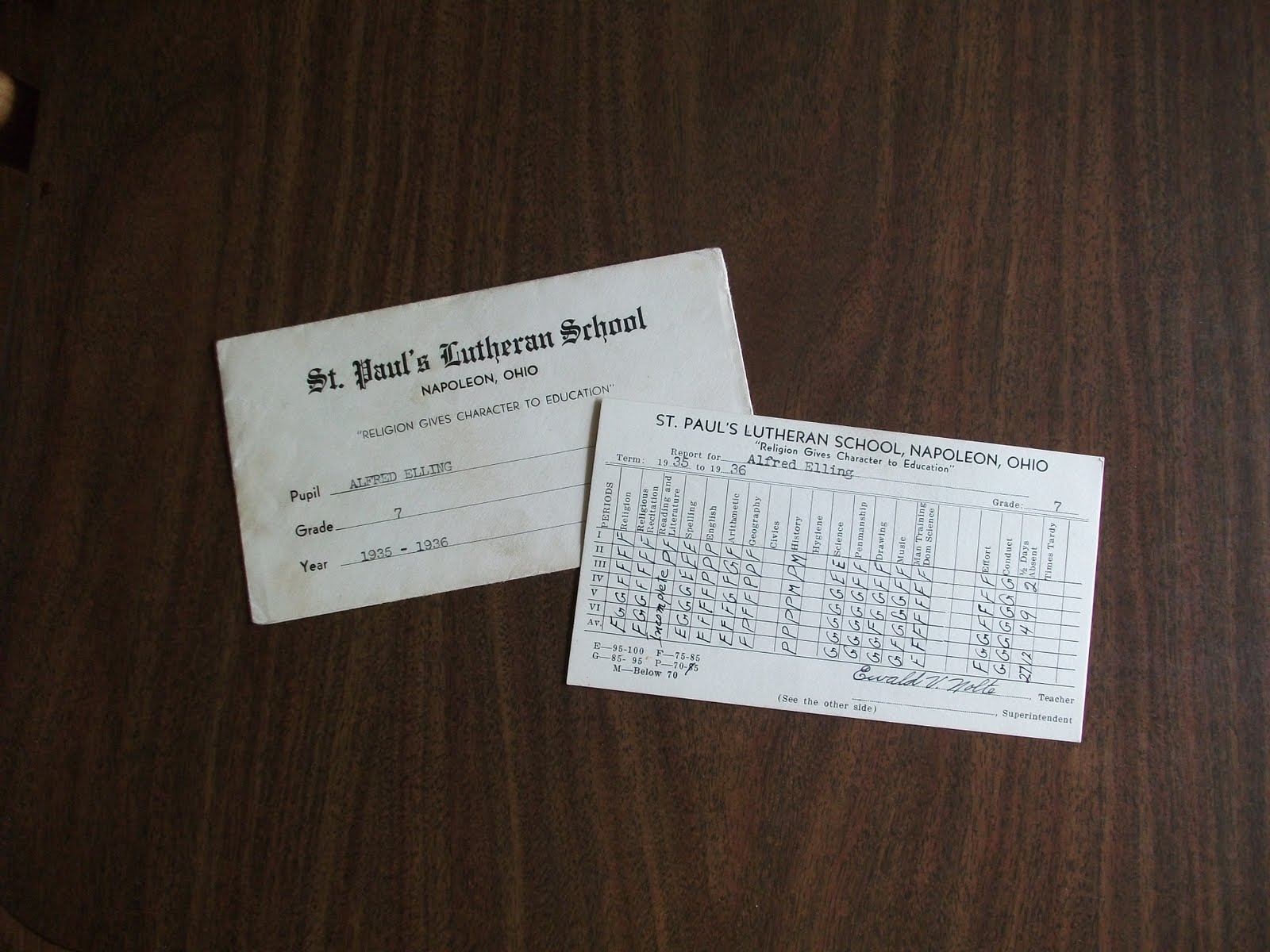
"Where did you get this?" Al asked when Pastor Kramer gave Al his 7th grade report card.

What a SURPRISE! 63 years lost in transition. Double-click on the top photo to see Al's good grades. (Letters represent percentage scores in "those days.")


Pastor Kramer explained that the librarian had cleaned a top shelf in the library and found an old, dusty box.

The box had been moved from the old church building into the new school library many years before.

It contained three old report cards dated 1935-1936. (Al's 7th grade years would have been 1933-1934, indicating typos on the report card envelope. He graduated from 8th grade and was confirmed in the Spring of 1935.)

 Grandma Elling signed the report card each period.

November 26, 2019

A Lovely Lunch with Aunts and Uncles

Originally, this post appeared on the Elling Family Blog on May 22, 2010. Since that time, we have lost some of these very special folks, but the memories remain.


Don, Jane, Dianne
At lunch today...
Alfred, Ginny, Don, Jane, Dianne
Alma and Lorna
Louise, Eleonore and Ron


Alfred and Ginny Elling

I thank God that I have been blessed with such loving, sharing aunts and uncles. This week we met for lunch, along with visiting cousins, Jane and Don, for a tasty lunch and then a "show and tell" of family heirlooms.

Louise Miller Fahringer


Each daughter or daughter-in-law brought something that they now have that was once owned by parents, Albert and Ida Elling. It was such a good time, and my pen was working constantly as I tried to record the stories surrounding each item. 

Those stories led to other stories...well, all I can say is, "Stay Tuned" for a series on their family treasures.

Alma Hicksted and Lorna Hausch
Eleonore and Ron Glanz

March 31, 2019

Another Photo From Threshing Day


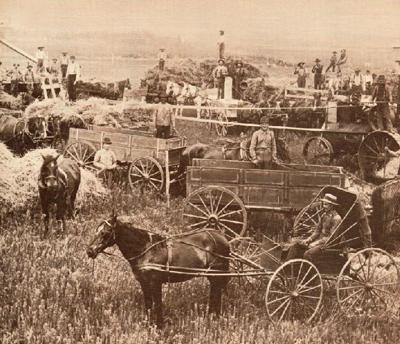
Aunt Alma Elling Hicksted wrote in her memoirs, " Then came the threshing days.  They were fun for us kids, and I think the women enjoyed themselves, too.  It gave them a chance to get together and bake and cook bountiful meals for their men and families.

There were about twenty families that had the threshing machine and all helped each other.  There were like two groups that lived close together - some ran the threshing machine and separator and lots of the others brought their teams and wagons and did the field work and brought the shocked wheat bundles loaded on wagons to the machine.
 Image result for threshing


There were lots of children and the older ones had to watch the younger ones.  Sometimes they were at one place for dinner and another one for supper.  And what good, big meals they cooked.  And the desserts - especially the pies and cakes.

About 9:30 a.m. was Frustuch or what is now called break time.  Sandwiches and cold water were taken to the men as they had worked long and hard already - usually bologna, summer sausage, and cheese sandwiches.  Then sometimes we had to walk from one place to the next and always several little ones in buggies.  On occasion we were lucky and a farmer would be going with a team of horses and wagon and would help the mothers put the buggies and little ones on his wagon and we would ride to the next place where threshing was to be done.  Even at that, those were such fun days. 

The photo below came from Alma and it is marked as a threshing day photo taken at a farm not far from the Seeman farm.  My father is in the buggy and he was born in September 1923.


Her identifications: "From the left is Paul Elling, Alfred Elling, From the other end is Rudy in buggy.
Next to buggy in front row is Arnold Sunderman (I was confirmed with him) and next smaller one is his brother Raymond Sunderman and next to him is Alma Elling Hicksted, a towhead and the one behind me is Laura Sunderman Grobrogge.  
The others I'm not sure of.  It's been too long, long ago.  I know there were some Meyers, Ludemans and the elderly lady is Minnie Seeman."

March 30, 2019

Letters and Photos from Aunt Alma Elling Hicksted


I've started to spring clean some of the genealogy boxes - a task that is long overdue!  Starting with the Elling box, the first family that really started me on this hobby.  One day, after Dad Rudy had his terminal cancer diagnosis, he and I were at their kitchen table and he started on some family stories.  That led to family talk and who was related. Eventually a notebook and pen had to come out for some notes and there it was...the beginning of creating the family tree.

The aunts and uncles helped, too, in building the trail back to Germany, but Aunt Alma was the consumate letter writer and family historian. Her memory was excellent, and I think I've saved every carefully handwritten note from her. Today I came across one I had forgotten about from 2006.  Included in the bright, yellow envelope was a two page (both sides filled!) letter and several photos that will be shared on the blog.  How could I forget that she had sent these? 


"This was taken on St. Rt. 65 south of West Hope at the Seeman farm.  We were visiting there on a Sunday night many, many years ago.
Front row L to R: Alma Elling, Dorothy Seeman Lange, Rudy Elling, Alfred Elling and Alvin Spoering.
Back row L to R: Elda Benien Arps, Emma Benien Rettig, Alma Seeman Rettig holding Wilma Seeman Lange in her right arm and Lorna Elling in her left arm (as it is facing us) Henry Seeman and Paul Elling"

My tow headed dad with the funny hat!  Al and Paul are looking so grown up with their ties and "big boy" hats.   I'm guessing this might be around 1926 or 1927?  What do you think?  The boys had their knickers on.

August 5, 2018

Christmas Toys and Family Traditions


Dad (of Jane, Kathy, and Bob; aka Uncle Alfred) remembers that he was about six years old when Santa brought him a cast iron toy bank lion on wheels, and the same year, Santa brought Uncle Rudy (Dad of Dianne, Ron, Connie, and Vickie) an elephant bank. He said unless their parents bought these from the Sears catalog, it was likely they bought them at Murphy’s Five and Dime store in Napoleon.

Dad said he saved pennies and dimes in his bank, and that the two boys rolled them around dining room table on the floor together. Santa usually brought each child one toy, and at each sister’s and brother’s place at the table, he or she would wake up to find an orange and a bag of hard candy.

I remember seeing Dad’s lion on their bookshelves and sometimes it gained a prestigious place on the mantel. A couple years ago, Dad gave his lion to Bob, where it makes its home now with Bob and Judy in Texas.

Does anyone else remember any special toys or books that you or your parents or grandparents received? My favorite toy as a child was a bride doll, and Mom sewed the bride’s dress and veil using her own wedding veil tulle that she cut. As a teen, I was wowed by a new typewriter (but before I unwrapped it I thought it might be box of coal).

Kris Kringle leaves one gift in our shoe by the bedroom door on Dec. 6th. We always go to Christmas Eve service, sing favorite carols, come home for a glass of wine and piece of pecan pie, leave Santa’s cookies out for him, and sing "Away in a Manger."

Does your family enjoy any special Christmas traditions?
Please leave your comments!


*This post appeared previously on Elling Family News on December 9, 2008.

February 3, 2017

Radio Man Saw Action

(This post first appeared on my previous blog, A Face to the Sun, on February 2, 2013.)

Recently, I came across this article written by Sheila Naveau, staff writer for the Northwest Signal, Napoleon, Ohio and published in the July 14-15, 2007 edition.  It features my uncle, Alfred Elling, and his story of service in World War II.
It definitely serves as a reminder of the sacrifices an entire generation made to protect our freedom.

"Liberty Center - Aug. 22, 1942, 20 year old Liberty Center native Alfred Elling was drafted into the U. S. Army.
He started his journey in Port Eustis, Va., with basic training, but when the trainees were shipped off to new destinations, Elling was not among them.  He and another soldier, Bob Bogart - also of Henry County - were left behind.
'I don't know why we weren't sent,' Elling said.
Until the next wave of draftees were brought in, Elling and Bogart had to work at the base.  'They (the base officials) didn't know what to do with the two of us, so they gave us a choice what we wanted to do,' Elling said. 'Bob took KP (mess hall) duty and I took guard duty so I could get a 24 hour pass when I was off duty.'
When the new draftees arrived, Elling said he had to go through basic training again.  'At least this time I knew what to expect,' Elling said with a laugh.
Corporal Alfred Elling

After the basic training was over, it was time for Elling to move on to train in a specific field.  He said he wanted to drive trucks, but the Army had other plans.  Elling was sent to Athens, Ga. for four months of radio school.  He learned to operate the communications radios and became proficient in Morse code.  He received his T5 stripes after completing his training.
'You hear it so long, it just comes natural,' he said.

Elling then spent a stint in Norfolk to be trained in amphibious operations, which he found later would come in handy as his battalion landed at Normandy.
March 15, 1943, Elling was stationed at Camp Davis, NC and was assigned to the 115AAA Battalion.  Elling's outfit spent six to seven months in South Hampton,England before shipping to Normandy.
'It was November in England and very cold,' he said.  'We slept in pup tents that only had three sides, so we took the tarps off the trucks to cover the opening to keep out some of the cold.'

Being a Morse code operator, Elling said he was at the front line a lot of the time. 'When Patton was moving forward, the radios followed,' Elling said.
His outfit had Sherman tanks that were equipped with bulldozers to clear hedge brush and make roads for convoys to get through.  Elling traveled in a trailer with his radio equipment.  He had large batteries and power to run his radios while they traveled.  
'I had to keep in touch with 13 corps,' he said.

The secret code was changed two to four times a day to make sure the Germans hadn't broken it and knew what the troop positions were.
Elling recalled many times his outfit sat along the roadway camouflaged, and he heard unidentified humming noises on the radio.  Knowing they had been detected by German fighter planes, Elling said they had to stay off the air waves until the planes were gone.
115th Gun Battalion, U.S. Army

When Elling's outfit went into Normandy, it was days after D-Day.  He said the casualties were tremendous.  'There were bodies everywhere,' he said.
When the outfit first reached Normandy, it was running low on ammunitions and the Germans were still coming.
'We rigged our 90's (ammunition) with a clock and fuse set to go off shortly after being shot,' Elling said. 'Normally, they explode on impact.'

Elling said his outfit went into France and took over a house in Sarreguemines, but the Germans continued to attack and Elling became ill, possibly by the fumes from the smoke.  He was evacuated to Nancy, France and then given his discharge...

Some 30 years after his tour in WW II, in 1974, Elling and his wife became involved in the Henry County Amateur Radio Club. The couple have been ham radio enthusiasts and continue to this day to talk to people all over the world who enjoy their passion for Morse code and ham radio.


Thank you for your service, Uncle Al!

September 2, 2016

Albert and Ida Elling - Napoleon, 1944


I found this photo of my grandparents, Albert and Ida Elling, among my treasures this morning. At one time they lived at 403 East Main in Napoleon and I believe this photo was taken in the backyard at that house. Are those telephone or electric poles beside them? I remember very little about the house except for the little rooms and the coal (?) stove in the living room. 


The last time we were in Napoleon, Jim and I took a ride in that area, trying to locate it off of Rt. 424/ Riverview Ave. Without a GPS or a Mapquest map, we were unsuccessful because I just couldn't quite get the location. Now, with a map in front of me, I see that we were very, very close.

This photo - one of the few my mother dated - is marked 1944. Uncle Alfred and Uncle Ron were probably overseas at that point and World War II was in full swing. Maybe there was a Victory garden in the backyard on East Main and I seem to remember grape vines or is that my imagination? Aunt Alma wrote in her book that this home had belonged to Henry and Amelia Schlegel (Grandma's sister and husband) and when they moved to Traverse City, Michigan, our grandparents purchased the house. I'm hoping that you will email me any memories you have of this home.

(This post was originally on the blog, Elling Family News, now deleted.)