Just what was happening in the world when the Ellings immigrated to America in 1859?
...Oregon was admitted to the Union as our 33rd state.
...A Tale of Two Cities by Charles Dickens was published.
...France declared war on Austria.
...The Comstock Lode, the most lucrative silver ore mine in history, was discovered near Virginia City, Nevada.
...The electric range and escalator were patented and the first Pullman car went into service.
...John
Brown and his followers, in an attempt to get weapons for a slave
insurrection, seize the federal arsenal at Harper's Ferry, Virginia (now
WV.) They were quickly captured,
convicted and hung.
...Billy the Kid was born, aka William Bonney
...Charles Darwin published Origin of the Species.
...The first oil well was discovered in the U.S. in Titusville, PA.
...Our president was Buchanan.
...One of the first reports relating tobacco to cancer was published in France!
...Capt.
James Simpson searched for the shortest way across Nevada, finding a
path that was then used by the Pony Express (1860) and the Overland Mail
and Stage (1861.)
April 2, 2019


Coming to Henry County
Once
the Ellings were through with their processing in New York City, how
did they then travel to Henry County, Ohio? I don't think it was by
railroad in 1859 because I can't find where the railroad had reached
Northwest Ohio by that time. It wasn't until after the Civil War that
the Baltimore and Ohio (B & O) came that far west.
My best guess is that they traveled up the Hudson River - on the river or along it by land - to take the canal boat on the Erie Canal from Albany, NY to Buffalo, NY. From there, they most likely traveled on Lake Erie to Toledo and then perhaps by horse and wagon from that point. Maybe they continued their canal journey from Toledo to Napoleon on the Miami-Erie Canal. It is only speculation, but however the trip was taken, it had to be a long, tedious one with four children and baggage.
 Their
destination was probably the New Hanover settlement in Henry County.
The baptism of their youngest child, Anna Maria Margareta, born August
2, 1860, is recorded in the Kirchen Buch fur New Hanover (Church Book for New Hanover.) So
it is likely that they knew people already here who paved the way for
them, perhaps giving them shelter and food until they could find their
own place to live.
Their
destination was probably the New Hanover settlement in Henry County.
The baptism of their youngest child, Anna Maria Margareta, born August
2, 1860, is recorded in the Kirchen Buch fur New Hanover (Church Book for New Hanover.) So
it is likely that they knew people already here who paved the way for
them, perhaps giving them shelter and food until they could find their
own place to live.
The records in the Kirchen Buch fur New Hanover have been translated and are available for researchers. The New Hanover Church later became Zion Church which later merged with St. Paul's Lutheran Church, Napoleon Township. From the introduction to the church book...
"In 1848 Henry Helberg and Dietrich Badenhop came from Germany, bringing with them the bodies of little Maria Helberg, aged 1 1/2 years, and Christian Dachenhaus, aged 17. These settlers needed a burial ground so they immediately decided to arrange for a cemetery and to build a church next to it. Among others, the well-known preacher, Rev. August Knape, served this little group. It was a group from this congregation which founded St. Paul's Lutheran Church, and when Rev. Damman was called, the congregation dissolved itself and merged with St. Paul's in Napoleon Township." (no page #)
For those who would like to experience what that canal boat ride might be like, visit the Providence Metropark at Grand Rapids, Ohio where you can take a canal boat ride with costumed historical interpreters. Going through a lock is very interesting. It is well worth the visit and something great to do while you are here for the reunion! Visit this website for details:
http://www.touring-ohio.com/northwest/toledo/providence.html
My best guess is that they traveled up the Hudson River - on the river or along it by land - to take the canal boat on the Erie Canal from Albany, NY to Buffalo, NY. From there, they most likely traveled on Lake Erie to Toledo and then perhaps by horse and wagon from that point. Maybe they continued their canal journey from Toledo to Napoleon on the Miami-Erie Canal. It is only speculation, but however the trip was taken, it had to be a long, tedious one with four children and baggage.
 Their
destination was probably the New Hanover settlement in Henry County.
The baptism of their youngest child, Anna Maria Margareta, born August
2, 1860, is recorded in the Kirchen Buch fur New Hanover (Church Book for New Hanover.) So
it is likely that they knew people already here who paved the way for
them, perhaps giving them shelter and food until they could find their
own place to live.
Their
destination was probably the New Hanover settlement in Henry County.
The baptism of their youngest child, Anna Maria Margareta, born August
2, 1860, is recorded in the Kirchen Buch fur New Hanover (Church Book for New Hanover.) So
it is likely that they knew people already here who paved the way for
them, perhaps giving them shelter and food until they could find their
own place to live. The records in the Kirchen Buch fur New Hanover have been translated and are available for researchers. The New Hanover Church later became Zion Church which later merged with St. Paul's Lutheran Church, Napoleon Township. From the introduction to the church book...
"In 1848 Henry Helberg and Dietrich Badenhop came from Germany, bringing with them the bodies of little Maria Helberg, aged 1 1/2 years, and Christian Dachenhaus, aged 17. These settlers needed a burial ground so they immediately decided to arrange for a cemetery and to build a church next to it. Among others, the well-known preacher, Rev. August Knape, served this little group. It was a group from this congregation which founded St. Paul's Lutheran Church, and when Rev. Damman was called, the congregation dissolved itself and merged with St. Paul's in Napoleon Township." (no page #)
For those who would like to experience what that canal boat ride might be like, visit the Providence Metropark at Grand Rapids, Ohio where you can take a canal boat ride with costumed historical interpreters. Going through a lock is very interesting. It is well worth the visit and something great to do while you are here for the reunion! Visit this website for details:
http://www.touring-ohio.com/northwest/toledo/providence.html
Johann Friedrich Elling Immigrates to the U.S. - 1859
What
a thrill it was to find the ship's manifest that held the names of my
immigrant gg-grandfather, Johann Friedrich Elling and his family! The
seaport of Bremen in northern Germany was the busiest of all for
emigration from Germany. The ships' lists that originated in Bremen,
Germany were destroyed during World War II, but fortunately, the U.S.
Immigration and Customs Service also created lists when the immigrants
arrived in the U.S.

Our immigrant Elling ancestors arrived on the Bremen ship, Elise & Mathilde, captained by Geo. Nordenholz, docking in New York City on June 18, 1859. If you enlarge the page above and look just past the halfway point, you will see:
Fred. Elling, age 39, male, farmer, Germany to U.S.
Maria Elling, age 41
" Elling, age 14
Hein. Elling, age 7
Dorothe Elling, age 6
Fred. Elling, age 4 (my g-grandfather)
A
later child, Anna, was born after they arrived in the U.S. Seeing the space of 7
years between Maria and Heinrich's births might indicate that a child or
two might have been born and died during that time. Because the family
probably spoke no English, maybe the officials had to guess at ages; at
least, they are in conflict with later census records (not always
reliable either) and death records available.
Most sources say that a trip from Bremen to New York City at this time would have taken about 30-50 days, depending on weather conditions. For the poorer immigrants, like the Ellings who traveled in steerage, the conditions were probably primitive and uncomfortable. Sometimes German cargo ships were temporarily adapted to carry passengers on the trip to America, and then they were reverted back to cargo ships on the trip back to Germany.
To do this, a deck would be built between the upper deck and the hold, called the zwischendeck or as we call it, steerage. Berths for sleeping here were made of narrow planks that could easily be removed for the return trip home to open up more cargo space. Few latrines were available and ventilation was poor. Passengers were to provide their own bedding, food, dishes and utensils. Water rations were supplied. Typically a traveler might pack sugar, flour, groats, salt, potatoes, bacon, bread, dried fruits, cracklings, sauerkraut, beans, honey and hardtack. Along with food, any other family treasures that would fit into their wooden boxes or trunks would be brought. Of course, farmers might also bring along seed to plant on their new American farms.
I
copied the whole manifest of the Elise and Matilde for this voyage and
every person was a German. Many occupations were noted, such as
locksmith, miller, carpenter, merchant, painter, apothecary, weaver,
mechanic, baker, shoemaker, barber, but the majority were farmers. Land
was cheap in America, especially as one traveled to Ohio and further
west. More than 300 immigrants were on the ship.
Our ancestors would have been processed in New York City at Castle Garden, the immigration station in those times. Castle Garden had only been "in business" since 1855 - before that, there were very few regulations for handling immigrants. The Elise and Matilde would have first anchored at a quarantine station below New York City where an officer would check for diseases and deaths during the voyage, as well as the cleanliness of the ship. Then, if passed, the ship would be allowed to travel up towards the Castle Garden depot where customs inspectors would board the ship to examine the baggage and then barges would ferry the immigrants to the Castle Garden wharf. It is likely that their baggage would be removed to a warehouse to be claimed later and the immigrants themselves would have entered the building to be given medical examinations and to register their names and other information asked. Help might be given as to how to get to their destination. After all, the Ellings still had a long trip ahead of them to get to Henry County, Ohio.
Beginning the Search for the Elling Immigrant
It
was a good genealogy conference, but I'm always glad to be home.
However, I am charged up to continue this blog and to keep searching for
more information on our family. It really is a life-long hobby!
One
thing a good genealogist learns early on is that just because someone
says it or writes it down doesn't necessarily make it truth. Searching
for family history is very much a detective's work...looking for truth
and documentation for everything.
Aunt
Alma was given a paper found in a Bible of the Mueller family, I
believe, which she passed on to me. The paper told the story of Dorothea
Elling, gg grandfather Fritz's sister...so a gg aunt...and her parents.
Here is one paragraph that I used to start to find who those immigrant
ancestors really were:
"Dorothea was born in Stellichte, Kirchspiel Walsrode Kries Fallingbostel, Province of Hanover, Germany. Another place it says she was born in Tiedel, Hannover, Germany. She came to America with her parents in 1859. Dorothea's mother was Reka Fuhrhop. Her father was Frederich (or Friedrick) Von Elling. He was Herr Von Tiedel (his title), sole owner of Tiedel, a village near Stealing, Germany. He was also a burgermaster. He let his secretary conduct all of his business and she cheated him out of everything and then he came to America with his family. Fred Elling was born in 1813, came to America in 1859 and is buried in the Lutheran Church, Freedom Township."
Very few of the items in the above paragraph proved to be true.
The villages of Stellichte and Tietlingen were part of kirchspiel (parish) Dueshorn.
From this parish, my German researcher found records of the Elling family.
 |
| Tietlingen and Stellichte are about ten miles apart, according to MapQuest |
Very few of the items in the above paragraph proved to be true.
The villages of Stellichte and Tietlingen were part of kirchspiel (parish) Dueshorn.
From this parish, my German researcher found records of the Elling family.
The
father of Dorothea and my ggg grandfather was actually named Johann
Friedrich and his wife was Anne Marie Engel Fuhrhop...we found the
marriage record as well as birth records of the children to prove this.
The German naming system of the time for this area was that the first name was the "saint's name" and the second name was what the child was actually called, so Johann Friedrich, born 1817, was called Friedrich (or Fred in America) and his wife was Marie. Reka may have been a nickname; I don't know.
I now have baptismal records back to about the late 1600's as our Elling family was in Tietlingen for about one hundred years and never does the name Von Elling appear. Preceding a name with Von was a common "legend" perpetuated by families who came to America and perhaps wanted to give some status to their surname. Our Elling family immigrated as farmers and were so in Germany, as well.
I've
written to Tietlingen to a man who has a good knowledge of the history
of the village which consists of about thirty homes today. He knew of
the Elling family, but was not aware of a title Herr Von Tiedel as owner
of the village or of an Elling as mayor/ burgermeister. Probably there
would not be a woman "secretary" in the mid-1800's in Germany, as well.
So I feel that all of that part of the story is fiction because none of
it can be confirmed. Later this paper states that Dorothea's grandfather
came from a titled family where he was secretary to the King of Hanover
and lived in a castle with a moat. My researcher knows of no local
castles and again the legend of acting as a servant to the king is a
common one and is probably fiction, too.
Later I will post some photos of Tietlingen, an area which looks much like the surroundings of Northwest Ohio, so I'm sure our ancestors felt right at home.
Many,
many Germans from Henry County came from the Visselhovede area of
Germany and our family was no exception. Quite a few settled in the New
Hanover settlement of Freedom Township where their native language and
customs from Germany could be continued in their new lives. More on that
later!
For fun, you can view the areas of Stellichte and Tietlingen from the satellite view by following this link:
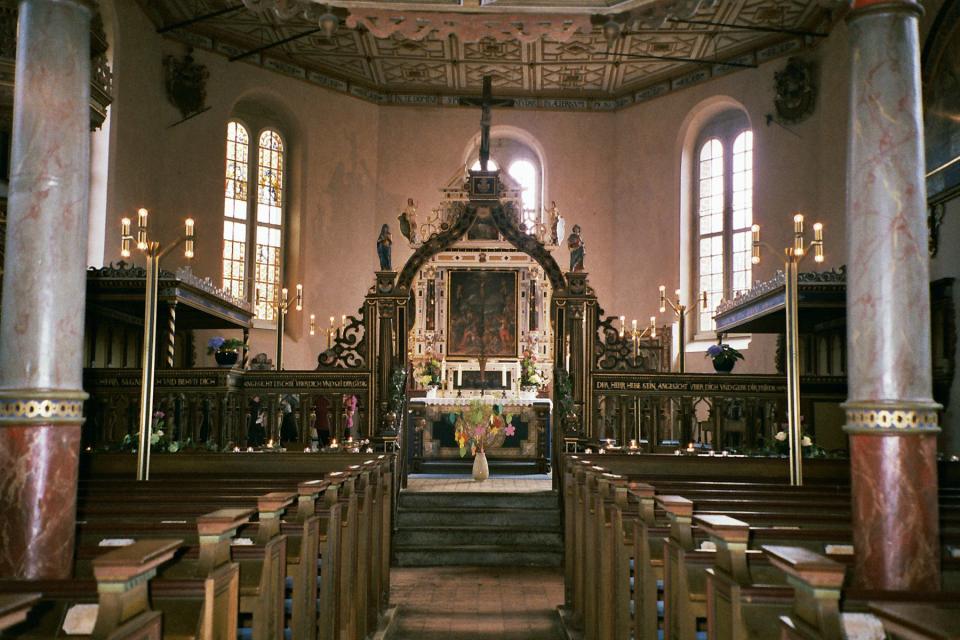
The Church in Stellichte
Thanks to the internet, we can take a look at Stellichte, the village where Heinrich Friedrich Elling (more often called "Fritz" or "Fred" on the records) was born and baptized.
If interested, check out the following websites which, of course, are in German. Just right click on your mouse, choose Page Information toward the bottom of the menu, then Translate This Page. It will be a rough translation, but good enough that you can get the gist of the articles.
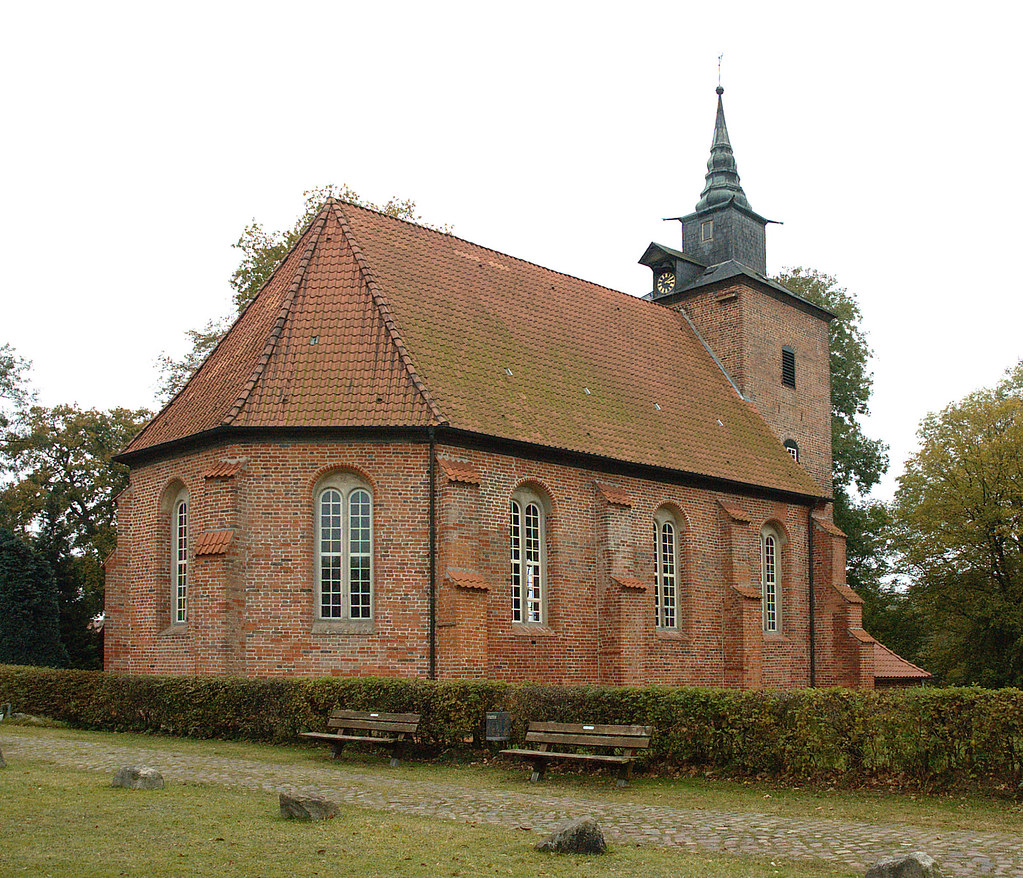
http://www.walsrode-net.de/tourismus/stellichte.html
http://www.stellichte.de/html/sehenswertes.html - nice photos
http://www.kirchenkreis-walsrode.de/pages/gemeinden/walsrode.php - Stellichte is toward the bottom of the page, but click on the Stellichte Church on the menu and you will see much more.
This blog is forcing me to become a LITTLE more organized. With your x-ray vision, you can imagine me at the keyboard, surrounded by boxes, notebooks, stacks of paper (at least one tree worth) and photos. If some of the next blogs seem out of chronological order, it's probably because something was buried, miraculously found and then posted! If you are copying some of the family history, I know that you can put it all in order your way!
I am also moving things from two former blogs into one blog. The Elling Family News is no more and I am migrating blog posts from A Face to the Sun to my now lone blog, At the Riverbend. So things will be out of order as I'm putting some new things in, too.
Back Another Generation - Heinrich Friedrich Elling


The father of Albert Elling, my great grandfather, Heinrich Friedrich Elling (known as Fred), was born in the village of Stellichte, Germany on October 24, 1852. I am proud of the two documents above that verify this birth and baptism. .
The birth record - Tauf-Urkunde - states that this record is in the Lutheran Church of Stellichte 1852 church book, page 41, number XV. Family Name - Elling,
Given Name - Heinrich Friedrich, born 24 October 1852 in Stellichte.
Parents - Friedrich Elling, kothne or cottager and his wife Anna Marie Engel born Fuhrhop.
Baptised 28 Nov 1852 in the church in Stellichte
Godparents - Heinrich Friedrich Engelke and Johann Heinrich Rohr (?)
At the bottom of the record is the church seal and repository for the record (Walsrode) and the date it was released to me.
The top image is a copy of the actual baptismal record as it appeared in the church book. Quite a challenge for most of us to read.
Heinrich Friedrich's father, (Johann) Friedrich, my great-great grandfather, was described as a kothner in Stellichte in the above birth record. This was a term for his occupation/social standing. What did it mean to be a kothne/ koetner in the 1850's in northern Germany? Most agree that this means the man had a little house with a stable for one or two cows, pigs, or sheep and perhaps some chickens. Koetners did not have horses, but instead used the cows for farming their small fields. The owner of those fields would have been a nobleman and the koetner was a renter of the field, usually paying 10% (den Zehnten) of his profits as rent. This rent would be paid in grain, brought to a special storehouse. The koetner was also obligated to work for the nobleman in other ways - constructing buildings or roads or cutting wood. It was a humble life. One source called the koetners "free slaves." When our ancestors heard about America, it mus have been very enticing to emigrate to a place where they could own land quite cheaply.
Freedom Township
Grandfather Albert and his siblings were the third generation of Ellings in the United States. Their father had come over as a child with his parents to settle in Freedom Township, Henry County, Ohio. Before we go further back in family history, I thought these excerpts from the History of Henry and Fulton Counties would give a good description of what the township was like when our ancestors came here in 1859.

"Chapter XX - History of Freedom Township
Everywhere
we turn we are bewildered by the fire of 1847. Even the record of the
civil organization of the townships cannot be found. It is known,
however, that Freedom was one of the first of the five townships
organized in the territory now composing Henry County; that it, and
Napoleon township, in 1840, included nearly, if not all of the said
territory north of the Maumee River, together with all of Fulton county,
which was organized in 1850. At that time, with all of its territory,
it had a population of only one hundred and five... In 1850 it contained
four hundred and sixty souls, and the taxable value of the property
amounted to $27,602. In 1860 the population...was four hundred and fifty
and the valuation $71, 697...
The topography is that in common with the balance of the county, level and the soil exceedingly good and fertile. The township is devoid of waterways, with the exception of three small creeks, the largest being Napoleon Creek and Oberhaus Creek. These traverse the whole width of the township.
The early settlers of this section were few; not more than a score lived in the township prior to 1860..
From 1860 up to the present time there has been an influx of Germans to this county, and especially to Freedom township. To this frugal people may be given a great deal of the credit of converting a wilderness into a garden, for the reason that they were not choice as to the kind of land Uncle Sam gave them, and whether a swamp or ridge, it was the same to them, and they went to work. Now Freedom township is a model of well-kept farms; now there are six school-houses, a couple of churches and scores of brick dwellings." pp. 227-228
This book was published in 1888, Lewis Cass, ed.
Here's the BEST part - the entire text of this book is online at http://www.archive.org/stream/historyofhenryfu00aldr
You can flip through the book and read as you please!
Subscribe to:
Posts (Atom)