Search This Blog

Showing posts with label Spengler's. Show all posts

April 12, 2020

Lydia Mina (Minnie) Spoering

  Welcome to our guest blogger today!
  
Jason Snow is the great-grandson of Lydia Spoering and her husband, Harry Loudon.   


 Most of what living memory can tell us about Lydia (Spoering) Loudon can be linked to this scene on the front porch of the family home at 320 East Main, in what was originally known as the Goosetown neighborhood of Napoleon, Ohio.  Pictured here are Lydia (1895-1960) and her husband, Harry James Loudon (1894-1968).  

In this home, the Loudons raised seven children: Dorothy, born 1916;  George, born 1917; Marie, born 1919; Norma, born 1922; Anna, born 1925; Ruth, born 1927; and Virginia, born 1932.  

One of her granddaughters recalled a memory that occurred on this porch.
"I was probably age 3 or 4, and as we were leaving after a visit, she taught me how to say 'Come back soon' in German
(Komm Bald Wieder).  She was on the inside and I was already outside looking back through the screen door.  We practiced those words many times until I got it just right, and when I did, my reward was a big smile and some happy clapping.  I still remember those German words today."
One grandson remembered that "Grandma would give you a penny if you gave her a kiss before she left."


Lydia Spoering was born on January 31, 1895, in Hamler, Ohio, the ninth child of Katharina Maria Floke, age 39, and Hermann Heinrich Spoering, age 50. She married Harry James Loudon on February 4, 1915, in Napoleon, Ohio, when she was 20 years old.  The observant reader might note the similarity of Lydia's wedding veil to the one in the photo of her sister, Ida, who married two years earlier and is featured in the preceding entry of this blog.  They appear to be the same veil, which probably shouldn't be surprising for a frugal, German-Lutheran family at this time.


Though we don't know when the Loudon couple first settled in the house in Napoleon, we do know something about their early years together leading up to that.  The Farm Journal Directory of Henry County, Ohio, 1916 listed them on page 137:
Loudon, H.A. and Lydia, 1 ch. farming, T25a 3h 2c, Westhope, Rchfld, 63 Ind. tel.  These abbreviation codes give details about their life at the time: 1 child, tenant farming on 25 acres in Richfield Township with 3 horses and 2 cows.  

This 1916 directory offers a look into this place at that time.  Advertisements and photos are throughout.  Ernest Spengler's establishment, for instance, is advertised as both a grocery store and in a separate ad, a saloon.  It's still in operation at the same address at 713 Perry Street, described online today as "storied pub and eatery, in operation for 135+ years, offering classic American grub and a full bar."  Spengler's is the last place this author ate during a visit back home several years ago.  I could imagine Lydia having been in the same room earlier, perhaps having stopped in for eggs and a chat with fellow townspeople.

Four years later, the family appears on the 1920 census with their first three children, farming in nearby Liberty Township.  We know there were other Loudon farms in the area, but don't know whether Harry and Lydia's moves were out of preference or necessity.

By the 1930 census, they were in the home on Main Street which was valued at $1500.  Her occupation was shown as homemaker, and his as "a truck driver for a flour mill."  

Harry's WWII draft registration (required even though his age of 48 at that time made him too old to serve) showed his employer as John H. Vocke and Son.  Vocke is included in the listings for flour and feed in the 1916 directory (p. 224) and he lived at 345 West Street, a half mile away from Loudons at the other end of their street.


Lydia with daughter, Ruth Loudon Switzer, c 1945
What we know about Lydia's personal life is limited.  Only a few of her living descendants were old enough to have remembered her directly.  Long after they stopped farming, Lydia and Harry continue growing food in a garden that one of her granddaughters remembers stretching to the back line of their property.  Most of the photos we have of Lydia show her outside, including the one here with her daughter, Ruth.  Ruth provided some commentary for the photo:
"The picture of my mother and me was taken in our back yard at 320 E. Main St., Napoleon about 1945.  The turban I had on was the way we used to do it.  We didn't have hair dryers back then, so we used bobby pins to curl our hair and then covered the hair with these turbans.  We thought nothing of going out in public with our hair pinned up."


One other memory came from one of Ruth's sons, who recalled her describing how Lydia would always vote the opposite of Harry, ultimately reaching a point where they wouldn't tell each other their voting plans.

 
Lydia Loudon c. 1955


Lydia died on February 24, 1960, in a care facility in Wood County, Ohio when she was 65 years old.  She is buried in the Forest Hill Cemetery in Napoleon, Ohio, not far from where she and Henry farmed during the first years of their marriage.  Her daughter, Dorothy, subsequently, lived in the Main Street home into the mid-1970s.  The house still stands, complete with what appears to be the same porch columns, as featured in the first photo. Both photos also show the addition on the right side of the house, originally built to provide a separate room for George as the only boy in the family.


Lydia's name lives on in the family via one of her great-great granddaughters.  Lydia Campbell was named after her by her parents, Sara and Gordon Campbell. Sara is a granddaughter of Lydia's daughter, Ruth, who is pictured above.
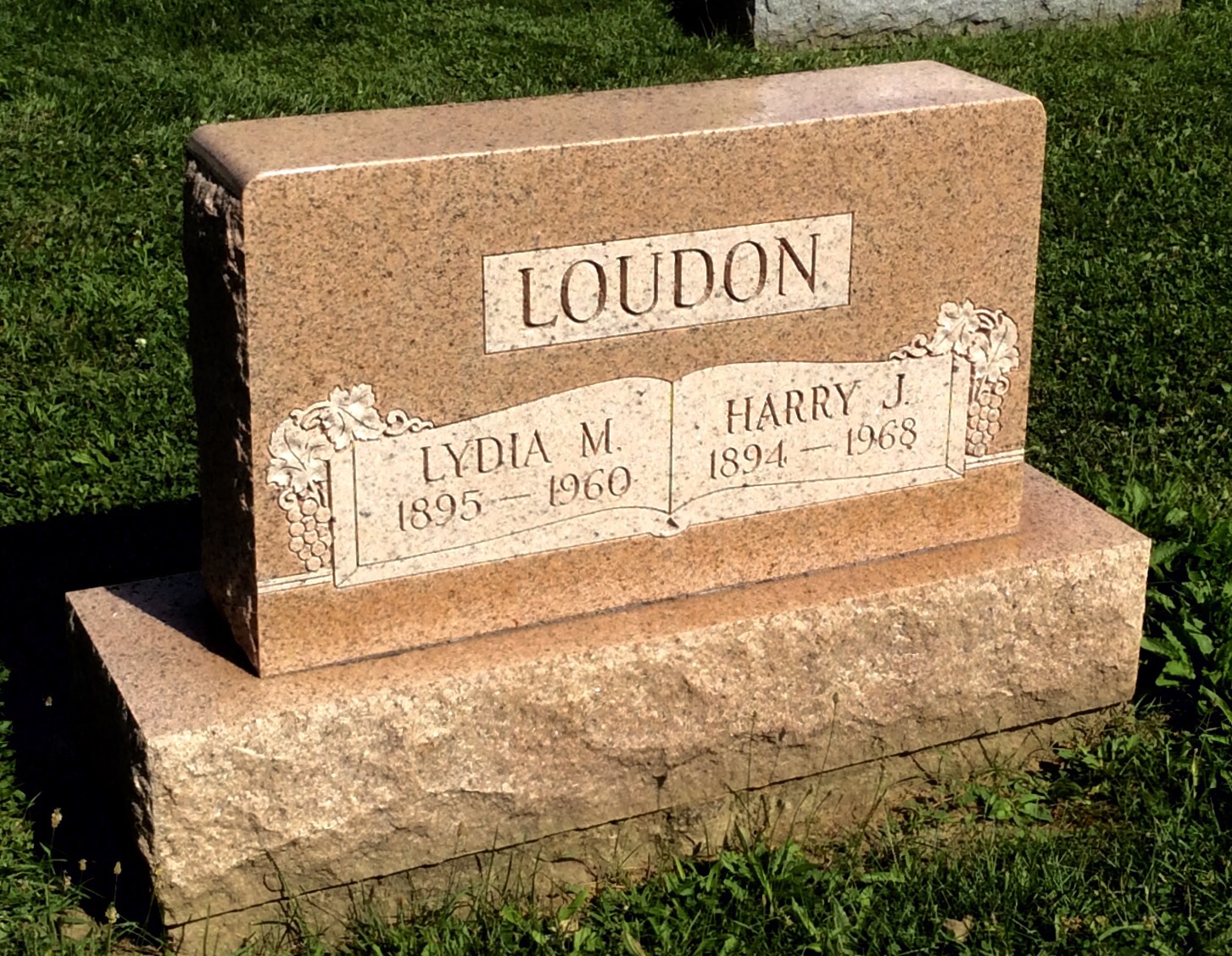


All of the photos, except the tombstone, are a part of the collection of Ruth (Loudon) Switzer, daughter of Lydia.  Thanks so much to Jason Snow for giving of his time and knowledge for this blog contribution.


February 3, 2017

Meet You at Spenglers!

The post originally appeared on my previous blog, A Face to the Sun, on July 5, 2012.)

 It won't be long and the cousins will be greeting each other at Spengler's in Napoleon, a place I've known of my whole life and "the oldest continuing business in Napoleon, Ohio," as author John Jaqua claims in his comprehensive book on the history of Spengler's.  I came across it on Ebay during a late night search, and was thrilled to win the bid.


Published in 1992 to commemorate Spengler's 100th anniversary, Jaqua's book tells the story of the grocery/ saloon from its very beginnings.  It's a remarkable story of one German immigrant, William Spengler, and his emigration from Prussia through the port of Hamburg to New York City, arriving at the end of the Civil War  in September 1865.  From there, he went directly to Defiance County where he and his family lived with Uncle Ludwig who had come to the U. S. five years before.

The family soon moved to Florida, Ohio, where William's father set up his own tailor shop.  When William turned 21 in 1877, he moved to Napoleon and began a job as a clerk in the grocery store of Gustave Kohler and by 1879, they became partners in the business.  Their grocery was located in the location of Wendt Shoes.  But in 1882, the partnership ended when Gustave bought out William for $2250 and they went their separate ways.  William took $1600 and bought a farm in Monroe Township, but with the rest he opened a grocery store in competition with Gustave and located about across the street from the current Spengler's.

In those days, it was customary for a saloon to be located at the rear of the grocery, so William procured his liquor license and the business did well.  (Jaqua points out that there were 20 saloons in Napoleon in 1887!  The largely German population of the county loved their beer.)  In 1892, he moved his business to the current location and the building became known as the Spengler block.
   
Jaqua describes the building throughout its hundred year existence - the spittoons and the centrally located heating stove between grocery and saloon, for example. At one time, a large mural of Gettysburg, painted in 1887, graced one long wall to honor all the Civil War veterans in the county.  The decorative "steel ceiling" was put into place some time in the 1890's.  

In my memory, I can envision a swinging door between the grocery and the saloon, the barrels of bulk items like peanuts in front of the counter, the large wheels of cheese, the big glass jar of dill pickles and the produce stands in the front of the store in the summer filled with sweet corn and other local goods.  Dad loved to buy his horehound candy there by the pound. Later on, when food was served in the back, it was a lucky day when one went there to get a double hot dog on rye bread and a root beer.


 I loved that Jaqua included in his book a column from 1973, written by Mary Alice Powell, the the former food columnist from the Toledo Blade. Fred Freppel was the owner at the time; you might recognize his face on the front of the book.

"December 30, 1973
Prettles and Oats are his Pride 
Bushel baskets filled with black walnuts, hickory nuts, and apples in front of Spengler's on Main Street in Napoleon, O. were the first inklings that here is something special among grocery stores.

Inside, the feeling of nostalgia continues and the first-time visitor is aware somebody really cares that the past is preserved in the present.  That somebody is Fred Freppel, who is known far and wide for a unique grocery store that boasts restaurant, just as unique located in the back of the store.

It wasn't easy, but well illustrates Mr. Freppel's determination to attain his goals in food merchandising.  Prettles is a butchering-day meat, made of scraps of both pork and beef, seasoned with salt, pepper and allspice, and extended with steel-cut oats.  The meat and seasonings were no problem, but steel-cut oats (as opposed to rolled oats) were not to be found in this part of the country.  After letter writing and several telephone calls, Mr Freppel found them in Cedar Rapids, Ia., and he now not only buys enough for his own prettles-making, but sells the oats by the pound...

Spengler's is probably best known for its bean soupl and chili and in sandwiches, the hot dogs, the kind with skins, come two in a whole wheat bread sandwich.  The roast beef, served in a bun, has the aroma of high quality meat...
The prices?  Everything is 60 cents at Spengler's.  Whether you have bean soup or a hot dog, it's still 60 cents - 'makes it easier to figure that way,' Mr. Freppel says. Coffee is still a dime there, but Mr. Freppel says his beer is far better.  He has a fetish about good beer and was quick to list the three attributes of draft beer: Clean equipment, making sure the beer is held at a constant, cool temperature, and selling a lot of it before air gets into it.

The restaurant sings of the good old days.  The booths and tables and chairs were purchased in 1933 and the back bar dates back to 1889.  Mr. Freppel is up on his dates because he began working in the store in 1929 when it was operated by Ernest, Herman and William Spengler.  He became owner in 1959.  Ray Detterer has been cooking the restaurant foods since 1945, but when he is on vacation, Mrs. Freppel steps in to make some of her German specialties.  One is baubalaspitule, which takes all day to prepare and cook.  It is a sauerkraut and ham rolled in homemade noodle dough and cooked in the ham broth - a German version of pigs in a blanket.

Mr. Freppel may boast beer, but the cheese he sells is his real pet.  As a boy, he worked in a cheese factory where his responsibility was aging the cheese.  He buys from the same Indiana source many other northwestern Ohio stores do, but he tends the cheese with loving care, turning it every 24 hours and keeping it at room temperature.  A wheel of cheese is on the grocery store counter where you pay, but there isn't a lot of room there.  Customer's selections share space with large cardboard boxes of chocolates, gallon jars of shelled black walnuts, and other old-fashioned delights.

As for the prettles, if you buy a pound, the directions are to fry it without shortening until it sticks, then turn it over and fry it until that side doesn't stick and keep it up until neither side sticks. Or you can let Mr. Freppel tell you himself.  He's at the grocery store-restaurant Monday through Saturday from 8 a.m. to 10 p.m."

I think when I go into Spengler's next time, I'll see it with different eyes, imagining all that Napoleon institution has seen in its 120 years of continuous operation.  It's a survivor, that's for sure, and I always look forward to visiting there.

If you have a favorite memory of Spengler's, please leave a comment!