Search This Blog

January 29, 2026

Jacob Newcomer - A Horrible Disease


Jacob Newcomer at age 67, Monroe, Michigan.
Photo taken Oct. 16, 1899.


I came across the death certificate for my great-great grandfather, Jacob Newcomer.  it really told a sad tale of a man who suffered greatly from gastric carcinoma, stomach cancer. His doctor treated him before the days of any real advanced treatments for cancer. He was under care from September 6, 1920 until April 13, 1921, a long time of suffering. 

The Monroe Evening News reported on Tuesday, March 22, 1921:

"CONFINED TO HIS BED.
Jacob Newcomer, at Ida, who has been very ill for several weeks, is very week and confined to his bed.
He is the last charted member of the Evangelical church and has been a good supporter. Last year he gave a very generous gift of $250 for missions and benevolence.
He is being remembered by his many friends. His daughter, Mrs. Geo. Doty, is constantly by his side."

He was widowed by this time, so he was attended by my great-grandmother, Alice Newcomer Doty. The cause of death was starvation and exhaustion, difficult for the caregiver to witness, as well. He died at the age of 87 years, 7 months, 21 days, a farmer.

Jacob Newcomer on far right.
"
"JACOB NEWCOMER DIED YESTERDAY

Jacob Newcomer, a pioneer resident of this county and father of L. (Lewis) W. Newcomer of the Monroe Binder Board company, died at the home of a granddaughter at Azaila, Wednesday afternoon. Mr. Newcomer was 87 years of age, and lived in Monroe County for many years.
The funeral will be held at Azalia Saturday afternoon at 1 o'clock, and at the Evangelical church, Monroe, at 2:30 o'clock. Burial will be made in Woodland Cemetery."
(The Monroe Evening News, Monroe, Michigan, Thursday, April 4, 1921.)


October 25, 2025

The Womanless Wedding - Bess and Lemuel Ordway


While looking through old photos, I came across this. I believe the "woman" is Lemuel Ordway and the "man" is Elizabeth/Bess/ Lizzie (Delph) Ordway, my great-grandparents. They were almost lifetime residents of Malinta, Ohio or its surroundings 
I've seen these weddings advertised in old newspapers, hosted by churches, and other groups in the community. This was a whole new side of Lem and Beth, ggrandparents who I knew and loved until my college years.


September 5, 2024

Grape School in 1901 with George, Guy and Harry Doty Attending


 From the Evening News, March 9, 1963.

Pictured are my great-grandfather, George Doty, from Raisinville, Michigan, and his brothers, Harry and Guy. 

Thanks to Marilyn Merkle Dunning for this find!

September 1, 2024

Little Arthur Elling


My father, born in 1923, had a brother who passed away as an infant in 1917. Born to Albert and Ida Elling on October 3, 1916, Arthur Elling died in York Township, Fulton County, at the age of five months, six days. As was the custom then, his photo was taken after death in his coffin as a remembrance.


His coffin was swathed in roses and carnations, and his body was probably prepared and laid in the coffin in their home. His mother, Ida, was the informant on the death certificate, signed Ida Elling, Delta, O. Arthur was born between their oldest son, Paul (1914) and their oldest daughter, Alma (1919).

He died of pneumonia in a time when antibiotics were not particularly known of or used by most folks. He was buried in the Lutheran Cemetery in Swan Creek Township, Fulton County, between Liberty Center and Delta, at 5565 County Road D. 


 The death certificate asked for the name of the father and mother and their birthplaces, but instead Arthur's grandparents names were given: Fred Elling, born Germany and Mary Rhores (Rohrs), born Germany. That could have been a language barrier problem.

Perhaps Ida and Albert, who were married in 1913, were living with his parents at the time?

August 14, 2024

We Can Stop at Ratsville


"Let's take a little drive to Ratsville..." Every once in a while, when I was young, my family would take a drive after dinner to check out the crops and perhaps stop for a treat.  Sometimes the stop would be in Ratsville, now a "ghost town" in Henry County located in Liberty Township. Once, back when I remember in the 1950s and 1960s, there was a store there in a pretty well-worn building where one could pick up very limited groceries or a treat. 

The history of Ratsville was noted in a book on ghost towns in Henry County, now out of print. Walter Shockey, Richard Helwig and Charlie Griffith researched and wrote the story which is still of interest today.

"Cloverleaf (Corners) (Ratsville) Liberty Township, 1886- 1903

Cloverleaf, which is sometimes referred to as 'Ratsville,' was located in the northwest one-quarter of the Northwest one-quarter of Section 21, Liberty Township, Henry County, Ohio. The land on which Cloverleaf or Ratsville stood was owned by the Joseph Hoover family. Later the ownership of the property was transferred to the Fred Silveous family who were descendants of Joseph Hoover.

In 1886, John Silveous built a general store with living quarters located above the store on the southwest corner of the present day intersection of Henry County roads 11 and V. The original store at Cloverleaf Corners was cheaply built and unpainted and covered with red and yellow advertisements for a popular chewing tobacco.


The store received its light from kerosene lamps and was heated by a potbellied stove which was housed on the second floor. The front of the store had a low porch roof across the front with wooden hitching rails near the entrance.

Cloverleaf was never much more than a crossroads with a general store. In the 1800s, there were many such communities in the old Black Swamp region of Northwest Ohio.  The reason these towns prospered was the fact that country roads all over the region were passable only in the summer. Rather than fight the rain, mud, and muck of the swampy roads, farmers would stop at the crossroads general store closest to their farms.

The Cloverleaf store was one of the Black Swamp's finer 'shopping centers.' It contained everything from groceries and hardware to shoestrings, yard goods, drugs and, of course, the old cracker barrel.

Just across the road from the general store in Cloverleaf was located a cheese factory, which was opened in the late 1800s and operated until the early 1900s. This factory faced east in the southwest corner of the crossroads. Farmers from miles around would bring their surplus milk to have it made into cheese. The cheese factory went out of business when Pet Milk in Delta and Van Camp's condensary in Wauseon established regular milk pickup routes in the area.

In addition to John Silveous, other operators of the Cloverleaf store were the Fether and Jewell families, and Carl and Dora Sturdevant Wiles. The Wiles purchased the store in 1903, but three years later, a ravaging blaze destroyed the building.

Today, in 1980, a small cluster of homes dot the site of old Ratsville, while the site of Cloverleaf was turned into farmland."

By the time that I was aware of Ratsville, a "new" store was built about a half mile from the original.  


According to the Henry County History, Volume Two, 1976, Ratsville was named because of a joke, but the name stuck. "...one day the neighbors caught a great number of rats and, as a joke, some boys nailed them to a board and put them on the front of the store. The owner at the time became angry and chased the boys and so they named the store Ratsville.

In the photo above, it looks like a gas pump was available instead of hitching posts. If one were a kid with a little money, candy and gum or a bottle of pop could be purchased. It was a part of our childhood, but the actual building is not there anymore.

Who else remembers Ratsville?

April 11, 2024

German Burial Practices Explained


How wonderful it is to welcome guest bloggers, Ava and Chuck Stanford, cousins extraordinaire!

Recently, Ava sent to me their 2018 travel journal from a trip to Germany and especially to all villages Elling-related. That's one of my dream trips, so it was especially satisfying to read their account of people met and visits to Tielingen and Stellichte, among others.

While there, they visited cemeteries, looking for Ellings, but were enlightened to the burial practices in Germany. Those graves will never be found!


Ava and Chuck wrote:

"During the early days of our visit, we were confused by the lack of cemeteries at several churches and towns.  The cemeteries we did find were very neatly maintained with gorgeous flowers and neatly manicured gardens surrounding new, polished headstones - all with relatively current dates. We saw very few dated before 1975 and virtually none prior to WW II.

'Where are all the people?' we wondered.  Where are all the old gravestones and especially those of the Ellings who we came to visit?  Tietlingen has no cemetery at all, and Stellichte's new small memorial park was not much more than 1/2 acre in size.  In fact, the church cemetery at St. George Christophorus Jodocus Ev. Lutheran Church in Stellichte was actually plowed over several years ago when it became to much to maintain, according to the custodian who is married to the church secretary and lives next door in her family's 400 year-old home.  Now the church maintains no cemetery at all, except for the original Von Behr family plots for whom the church was built in 1608.

Church at Stellichte

Well, here is the rest of the story...it turns out there are several unusual things about burial laws in Germany.

  • When you buy a burial plot n Germany, whether it be one plot or a family grouping of 8-12 plots, you only purchase it for 30 years - that is 30 years from the date of the first funeral.
  • The plot may be repurchased again at the end of the 30 years and again at 60 years.
  • The policy results in part from emigrants and family members moving away from the local area, leaving no one to care for the gravesite nor anyone who has an ongoing connection to the deceased.
There are strict regulations pertaining to maintenance during the 30 year period to assure consistent appearance of the sites - sort of like an HOA that maintains the appearance of your neighborhood.

  • Burials are restricted to only wooden caskets. Metal caskets and burial vaults are strictly prohibited, and, in fact, unheard of at one church we visited.  The idea is that wooden caskets will decompose in 20-30 years and be 'totally' recycled by the time the plot s resold in 30 years.  
If any remains (such as femur bones that are the last to decompose) are found when excavating a 'reused' site, they are simply buried deeper and the new occupants are added on top of the existing site

One pastor told us there was only one metal coffin in his entire cemetery that belonged to a woman who had committed suicide using poison.  The woman had ingested such a massive dose of poison that the authorities were worried about the decaying body polluting the ground water, and they insisted a metal coffin be used to contain any contamination.

The policy is the same for cremation, where cremains are only allowed to be buried in wood urns that will deteriorate withing the 30 year time period.

Very few historically important gravestones are retained, and those are 'only for decoration,' according to one pastor.
********

Here is a great website to read about this topic, adding even more information.


January 31, 2024

IF by Mable Baker


If you could see your ancestors 
All standing in a row, 
Would you be proud of them?
Or don't you really know?
Some mighty strange discoveries are made 
In climbing family trees, 
And some of them you know
Might not particularly please

If you could see your ancestors
All standing in a row
There might be some of them
You wouldn't care to know
But here is another question
That requires a different view.
If you could meet your ancestors
What would they think of you?

December 21, 2023

Henry Frederic Christian Myers and Mary Caroline Young Myers


Christian and Caroline Myers, my husband's great-great grandparents, were both born in Germany in the Hanover region.  Christian, born March 6, 1814, named his birthplace as Neerseen, a principality south of Hanover.  Caroline's birthplace, as told in her obituary was Hevenseen, Lower Saxony and her birthdate, April 17, 1812. My guess is that they lived in the same village, as travel to find a wife was quite limited and most married people from their own immediate area.

The couple married in March, 1840 and immediately emigrated out of Germany, settling in Hocking County, Ohio. They settled in Laurel Township, Hocking County, and joined the St John Lutheran Church there; here all their children were baptized and confirmed.  They were farmers, like most others in that county and their children farmed, as well.

Their oldest daughter, Dora (Teena, Jena) Myers married John Wesley Kline and they had a son, Daniel, my husband's grandfather.  Dora's siblings, as I know now, were Jacob, Frederic, Caroline, Louisa, Melvina, Elizabeth and Wilhelmina.

Christian and Caroline lived on a Laurel Township farm their whole lives and that is where death found them.  Christian died on March 24, 1884, at 70 years old.  His obituary appeared in the Hocking Sentinel, Logan, Ohio, on April 10, 1884:

"Mr. Henry Frederick Christian Meier was born March 6, 1814, in Neersen, Germany, and died at his late residence in Laurel Tp., Hocking County, Ohio, March 24, 1884, aged 70 years, 18 days. 

The deceased was consecrated to the Lord through the sacrament of Holy Baptism in his infancy, and when 14 years of age, was confirmed in the Lutheran Church and thereby admitted into full membership of said church.

In 1840, Mr Meier joined himself in holy matrimony to Miss Mary C. Young, and this newly married couple soon afterward left with the Rehren family their native country and came with them to America and settled in Hocking county.

The married life of Mr. and Mrs. Meier was a happy one, and was blessed with 9 children, 2 sons and 7 daughters, of whom, however, 3 daughters have preceded their father to eternity.

The deceased was an industrial and honest man, a loving husband, a kind father, bringing up his children in the nurture and admonition of the Lord, and an active and faithful church member.

In general, he possessed the great gift of good health, until about four years ago , it began to fail him. An aillment of the lungs took hold of his otherwise robust and vigorous constitution. This complaint subsequently resulted into dropsy (edema). But all these sufferings, the deceased bore with truly Christian patience and resignation, firmly believing and ardently hoping admidst sighs and prayers, that Christ, his Savior, would soon come and deliver him from his sufferings, and translate him from this world of sorrow into the Heavenly Kingdom.

This wish was granted him on Monday noon, March 24th, when he fell asleep, as we hope, in Jesus, to live with HIm in joy and bliss forever.
His funeral took place on Wednesday, and was conducted by Rev. L. F. Miller, Pastor of the Ev. Lutheran Church of Laurel Tp., of which the deceased had been a member for over 40 years.

The widow, two sons, four daughters, and seventeen grandchildren mourn his departured.  May the God of all consolations and blessings also console and bless these bereaved ones."


St. John's Lutheran Cemetery, Maysville, Hocking County, Ohio

Caroline passed away on April 23, 1888 - her obituary:

""Departed this life, April 23d, 1888, at her residence in Laurel Twp, Hocking Couinty, Ohio, Mrs. Mary Caroline Myer. The deceased was born April 17th, 1812 in Hevenseen, Hanovre, Germany.

In early infancy, she was given to the Lord through the sacrament of Holy Baptism and at the age of 14 years, she was, by the rite of confirmation, received into full membership of the Evangelical Lutheran Church.

In 1840, she was married to Mr. Christian Myer. To them were born nine children, of whom four have preceded their mother to eternity and five, 2 sons and 3 daughters, survive her.

Shortly after their marriage, Mr. and Mrs. Myer left their native country and emigrated to the United States of America and settled in Hocking County, Ohio.  The deceased has lived in the community for 48 years.  Four years ago, the departed had to experience the severe loss of being deprived of her life's companion, Mr. Myer, by death.  She bore this loss with Christian patience and submission, hoping to meet  'ere long in a 'better land.'

In general, the deceased enjoyed good health until about 8 months ago, symptoms of dropsy made their appearance.  This ailment grew daily worse.  During her sickness, she gave proof of her strong faith in Christ my clinging firmly to Him and by expressing a great desire to be delivered and go to her heavenly home.

The days of her early pilgrimage numbered 78 years and 6 days. Her funeral took place April 25th and was largely attended by friends and relatives.  After suitable service in the Ev. Lutheran Church, St. John's of Laurel Tp, of which the deceased had been an active member, by Rev. L. F. Miller, her body was laid to rest by the side of her husband to await the summons of the Lord for resurrection on that great day.

Two sons and three daughters and 24 grandchildren mourn their severe loss which to her is endless gain.  May God absolutely comfort them."


July 27, 2022

Confusing Cousins

It seems like a struggle to me to classify cousins into first, second, third, once removed, etc.  

It was always obvious to me that my first cousins were the children of my aunts and uncles.  You know who you are! We share grandparents.

But who is a second cousin?  They are the children of my parents' first cousins. So if my dad had a first cousin, Eldor, his children would be my second cousins.
Or, in another view, we share great-grandparents.

My third cousin would share a great-great grandparent with me, and so on, adding greats.


Now for the "once removed" which refers to generations between us.

So, my first cousin once removed is my first cousin's child 
My first cousin's grandchild would be my first cousin twice removed.

How many generations are between me and our common ancestor?

I don't know if I will ever be clear on it all, especially as it progresses further and further back in time.  Maybe it's just easier to call everyone related in any way "cousin"!


Perhaps this chart from Family Search would help -


July 12, 2022

A Christmas Souvenir From Your Sunday School Teacher, Henrietta Delph

 During the Christmas and New Year Season of 1902-1903, Henrietta "Sue" Delph presented a little gift to her Sunday School students at the Lutheran Church in Malinta, Class No. 11.

Her photo was featured on the front with the class roll and a few Christmas verses inside.


The class roll:

Blanch Graffice        Otto Hemsoth        Maud Dauber        Roy Haffey        Leah Parrett

Earl Stevens        Gladys Burr        Floyd Long        Emma Detrick        Josie Heckler

Kata Detrick        Nettie Austermiller

Henry Giest, Superintendent and Rev. N. Barnett, Pastor

July 5, 2022

Another Philip and Elizabeth Witzgall Delph Family Photo

 This family photo, presumably taken on the Delph farm, included spouses and grandchildren.  Jim Delph and I put our heads together to label as accurately as possible.  Even then, we could not identify the grandchildren who seem to make up the first row, sitting on the ground, except for the oldest girl which I am fairly sure is Marie Ordway (Baker).


The photo was estimated to have been taken between 1913-1917

From Left to right, naming the men and the women behind them:

Morris Babcock, Jacob Babcock with Cora Delph Babcock behind him

Clarence "Cooney" Delph with wife, Margaret behind him.

Cecil Delph, unknown woman

Elizabeth Witzgall Delph and behind her Henrietta "Sue" Delph and unknown man

Philip Delph

Ottis "Pat" Delph with wife, Elsie standing behind him

Lemuel "Lem" Ordway with wife, Elizabeth "Bess" Delph Ordway behind him

Mandus "Jerry" Spangler with wife, Julia Delph Spangler behind him.

George Delph with wife, Emma Delph behind him

***If you can help with identification, please chime in in the comments.  Your comments are monitored and probably won't show up for a day or two when approved.


June 30, 2022

A Fragile Treasure - The Ordway Family Bible Record


 This family treasure was passed down to me from Marie Ordway Baker's son, Robert.  It is one very fragile page of the family record of the Richard and Sarah Hill Ordway Bible, my great-great grandparents, listing their children and birthdates.  

I didn't scan the back side of the page, but their marriage record alone rests there: 

Richard Ordway and Sarah Jane Hill was married the 8 day of September 1858.

Also with that record was a slim piece of yellowed paper, marked State of Ohio, Wood County, declaring the marriage of Mr. Henry L. Ordway with Miss Lizzie Delp, on January 2d, 1898, signed by Rev. L. O. Thompson, Church of Christ.  My great-grandparent's marriage certificate.  It doesn't get any better for a genealogist.

June 22, 2022

High School Graduation in Malinta - Frederick Ordway

Class of Nineteen Hundred and Twenty

Malinta High School

Commencement Exercises

Saturday Evening

May Twenty-second

At eight o'clock

K of P Hall


Class Motto: Striving

Class Colors: Rose and Silver Gray

Class Flower: Sweet Pea


Class Roll:

Ada K. Smith

Miriam L. Russell

Nola Mildred Latta

Frederick Ordway


Dallas G. Greenler, Principal

Margaret McKee, Asst. Principal

June 16, 2022

A Ladies' Group in Malinta, Ohio

I'm back to working on my great-grandmother's family, the Delphs of Malinta, Ohio, and Crawford County, Ohio.  Search for the many other posts on this blog related to this family. 

Thanks to Jim Delph for the "red box" of Delph goodies that I am working my way through right now.  In the box was this picture of a group of lovely ladies, including my great-grandmother's sister, Henrietta "Sue" Delph.  It was probably taken in Malinta as she was young in the photo, but what group was it?  A choir?  A literary group? A church group? 

On the back of the photo were the ladies' names written in what now is a very, light pencil.  I have attempted to transcribe the names, but some were just too light.  Maybe you can help.


Edith Hoffrey, Polly Dauber, Myrtle Heckler, Lora La... , Ella Hemsoth
Julia Herge, Harriet B... , Kate Purs..., Rose Hurst, Annie Klingler, 
Gertrude Honeck, Henrietta "Sue" Delph, Mar... Hoffrey, Lucille Dauber,
Bertha Cl... , Lulu Dunbar

I don't know if the names were in order of appearance or random, but if you recognize someone, please comment.


*All comments are reviewed before posting, so they will not appear for a few days until approved.

May 3, 2022

What Happened to the Headdress? A Spoering Family Mystery

 About five years ago, I wrote this post about German Wedding Traditions, brought about by a photo I found of myself, dancing in the hog trough at my younger brother's wedding.


Then, last month, I was asked to give a program at our genealogical society, and I chose that same topic.  I took some time to really delve further into the subject, especially as it applied to my family.

I looked at three wedding photos I had of three of the younger Spoering sisters - 
Lydia, Kate, and Ida, my grandmother.  My first revelation was that all three wore a dark dress, just as they would have in Germany at the turn of the century.  It was all about practicality, and I'm sure those dresses served them many years.  


Of the three sisters, Kate was the first to marry Wilhelm "Dutch Bill" Tietje in 1911.  The groom had his best suit on with a large flower stem in his lapel. 
The flower is myrtle, representative of love and fidelity.  A close look at the bride's headdress shows the same flower on top and a strand hanging down on the side.
Notice the wide hem at the bottom of the sheer veil.


Ida Anna Katherine Spoering married Albert Louis Elling in 1913.  A very close inspection of her wedding headdress revealed that it was the same as in the previous photo, only a little reworked with the myrtle hanging down as before.  The wide hem at the bottom confirmed that it was the same veil.  The dress pattern is the same used by Kate, and it would be a valid guess that the dresses were handmade.


Lydia Spoering married Harry Louden in 1915, and the headdress is the same, although we can not see the whole veil.  Myrtle appeared in both the headdress and the groom's corsage.

As for the other Spoering sisters, I do not have their wedding photos to know if they also wore this item.  I only know of its use from 1911 - 1915. Mary married in 1900; Freida in 1917, Anna in 1903, and Sophia in 1904 and Amelia later. If anyone would be able to share those wedding photos, it would be very appreciated.

Once, long ago, I was told (source not remembered) that the wedding headdress had been preserved and placed into a large frame covered with glass to protect it.  I've envisioned this for many years as a family heirloom that lived on somewhere. I thought one aunt had it, but her son assured me that she did not.  

So...does anyone know if this wedding headdress was preserved and where it is?
That is the question to answer.  Any clues or knowledge would be appreciated.

Please comment!  Know that all comments are moderated and so will not appear immediately.  It takes a day or two.


March 10, 2022

Barnhart Kline Jr.'s Sons - Barnhart III, Henry, and Peter Comstock Kline


Barnhart Kline III -

Barnhart Kline III was born to Barnhart Kline Jr. and Rosetta Chapelles on May 22, 1843, in Sandusky County, Ohio.  He was their first son.

Barnhart, known as "Barney," enlisted on August 4, 1862, into Company K of the 100th Ohio Infantry, at 19 years old. On September 8, 1863, his company, inexperienced in battle, led by General Ambrose Burnside, met a Confederate unit, led by Alfred E. Jackson, on the bridge at Limestone Station.  Prior to this the 100th had done a lot of marching, but no fighting.  There the 100th ran out of ammunition and was consequently surrounded by the enemy.  Two hundred and fifty men were captured and placed on a train bound for Richmond, where there were numerous prisons for Union soldiers.  

Eighty five of those 100 died in prison in Richmond.  Barney was eventually in a prisoner exchange and, upon his release, made his way to Atlanta and caught up with his regiment there.

On August 4, 1864, Sherman decided it was time to move forward and seize the railroad to East Point.  He ordered Schofield to advance his Twenty-Third Corps, plus Major General John M. Palmer's Fourteenth Corp and "not stop until he has absolute control of that railroad.  The next day only one Union brigade, Brig. General Absalom Baird's, moved forward and seized an entrenched skirmish line with 140 prisoners at the cost of 83 killed and wounded.  

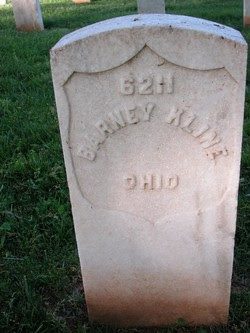
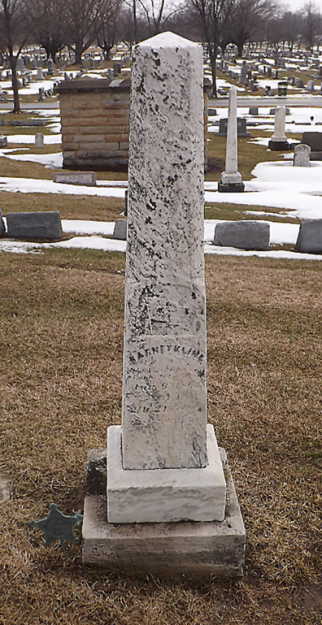
The next morning, Schofield ordered part of his corps to attack at Utoy Creek.  By the time the Union advanced, the Confederates had taken a position on a ridge and they were ready.  They had strengthened their works with logs and branches of trees.  Union soldiers had heard the felling of the trees.  Into this entanglement and up the slope came the Union charge, including Barney, and the Confederates opened with heavy musketry and cannon, driving them back.  The Union tried again and was repulsed.  Seventy six men were killed, 199 wounded and 31 captured. against 15-20 Confederate men.  Barney Kline was killed in this battle at Utoy Creek.  After the battle at Utoy Creek, the bodies were left on the field of battle, as there was no time for other than perhaps a quick burial.  Later the Marietta National Cemetery was created and Barney III's body was moved there.  However, the family also erected a cenotaph in the McPherson Cemetery in Clyde, Ohio for him.

           Fremont Journal, August 26, 1864, page 7

                                        Monument at Marietta National Cemetery, Marietta, Cobb Co., GA

                                         
                                         Centotaph for Barney Kline III, McPherson Cemetery, Clyde. Ohio   
                                           Note G.A.R star on the left side.

Peter Comstock Kline was named after his maternal grandfather, Comstock Chapelles (Rosetta Chapelles Kline), and was born on February 25, 1845.  His obituary gave a very complete summary of his life, except that he was married twice.  First, he married Helen Tichenor in 1872.  They divorced in December, 1885, at the request of Helen, on the grounds of willful absence for three years.  She was granted custody of their child - probably Russell.

                             The Sandusky Register, February 25, 1940, page 12

Another obituary added yet more facts to his life story: 
"PETER C. KLINE, VETERAN OF CIVIL WAR, CLAIMED BY DEATH
Death claimed the life of Pete Comstock Kline, 95 year old Civil War veteran and sole survivor of the C. B. Gambee Post No. 33, G.A.R. at his home at 205 North West street at 11:50 p.m. Monday.  His passing was attributed to the infirmities of old age.  In failing health since June 12, 1939, when he suffered a hard fall on Main Street, Mr. Kline has been confined to hishome for over a year.  Despite the delicate condition of his health, his mind was active and he took a keen interest in world affairs which he followed nightly by listening to Lowell Thomas radio broadcasts.

PARADE PAID TRIBUTE
His last public appearance was on Memorial Day when the parade stopped in front of his home to pay tribute to the city's last Civil War veteran as he stood on the porch supported on the arms of war veterans.  A recent illness brought on by the intense heat prevented him from attending the Ohio convention of Civil War veterans held at Sandusky last weekend.
He received his host of friends at intervals during the past year and enjoyed their company  in spite of the fact he was unable to make his daily trips 'uptown.'  His death last night thwarted his ambition to reach 100 years of age.
Believed to have been the oldest resident of the city, Mr. Kline was born February 15, 1845 in York township on the homestead which is now the Gypsum Cherry Farm.  He was the son of Barnhart and Rosetta Kline.  He spent his early boyhood in this vicinity and remembered well much of the early history of the city and surrounding county.

ENLISTED AT 19
As a lad of 19, he enlisted February 27, 1864, in the A company of the 10 regiment of the U.S. Army at Cleveland and served three years in the Union Army before being discharged at Ft. Ripley, Minnesota, February 27, 1867.  He fought in five different engagements including the Battle of the Wilderness - May 6, 1864, Battle of Petersburg - June, 1864, and the Battles at Weldon railroad, August 18, 19 and 21, 1864. He was wounded in the left arm at the Bottle of the Wilderness and while in the hospital, he had the pleasure of shaking the hand of Lincoln who visited the wounded men.  From November, 1865 until his discharge, he was among the Indians in Minnesota at Ft. Ripley, Leach Lake and Crow Wing.

MARRIED 54 YEARS
During his active life, he was a farmer and a railroader, having been an engineer for over 18 years. On June 1, 1886, he was married to Jennie Stone, they recently having celebrated their 54th wedding anniversary.  Besides the local widow, two sons, Dr. Walter Kline, local dentist, and Russell, at home, survive.  A daughter died in infancy.
He has been an active Mason and served a four year term as Master of the Blue Lodge.  He also served several terms on the city council and held the office of Post Commander of the C. B. Gambee Post No. 33 for a good part of the last 50 years.  The organization originally numbered 163 members.  He was also an honorary member of the American Legion and Veterans of Foreign Wars.
Funeral services will be held Thursday at 2:30 p.m. from the Young funeral home with the Rev. D. J. Black officiating.  Burial will be in the Bellevue Cemetery. Mr. Kline will be accorded full military honors at the grave which will be in charge of the American Legion.  Members of the Masonic Lodge will be pall-bearers..."

Henry Edward Kline

Little could be found on this youngest son, Henry, born in 1847 and died in 1902.  His obituary was helpful in that it established that he never married and had no children.

In the Bellevue Gazette, August 21, 1902: 

DEATH OF HENRY KLINE

Henry Kline died Wednesday, at eleven o'clock a.m. at Dr. Orwig's sanitarium on East Main Street, aged 56 years.  Mr. Kline had been in impaired health for several years and death was due to messenteric consumption.
Deceased was born and raised in York township and was a son of the late Barnhart Kline.
He was unmarried and leaves a sister in Michigan and one brother, P. C. Kline, the well known York township farmer.
Decease was an active member of the Blue Lodge Council , Chapter, and was also a Knight Templar, being a member of Norwalk Commandery. The funeral services were held from the home of his brother, P. C. Kline, at 9:30 o'clock Friday morning and at the Free Chapel at 10:00 under the auspices of Norwalk Commandery, Knights Templar.  Interment will be in Free Chapel Cemetery."


February 26, 2022

More on Barnhart Kline, Jr., Resident of Sandusky County, Ohio

 To reveal a bit of Barnhart Jr.'s character, on October, 18, 1864, he placed this notice in the Norwalk Reflector
"Barney Kline of Bellevue offers to bet $3500 on Lincoln's reelection and adds the following, which we give for the benefit of the peace, ladies, if there are such in these parts.  He says, 'I offer further to marry any Union woman who will bring me a person who will accept the above bet, or who will herself put up the sum on the same terms.' "
Note that his son, Barney III, was killed in the war in August, 1864.

Another election bet occurred in the Bellevue Local News on July 17, 1880: "Barney Kline is a queer genius, as everybody knows, well upon 75 years of age, yet his confidence in the future is unshaken.  He offers to lay a wager of $1000 that Garfield will be our next President, and also $1000 for each of the next for succeeding presidents that they will be Republican in politics and also $1000 that he will live to win the bets and rake in a pile."
Whether the bets were won or not has not been determined.

After Barnhart Kline, Jr.'s death in 1885, the estate was brought into a lawsuit for a phaeton buggy that was repaired and given new harnesses and then the bill was outstanding. The estate lost that suit. 
Many land transfers took place among the children of Barnhart in 1886 in York Township as was directed by the will.


In 1993, the columnist, Bill Oddo, of the Bellevue Gazette, Bellevue, Ohio, wrote about Barney Jr. in such an interesting way.  The first article, entitled "Bellevue Has Had 'Town Characters'" appeared on September 7, 1993, on page 4 of that newspaper:

"Every small town has its 'characters,' those people so well known, that you need only to mention their first name to identify them to others.  Bellevue has had its share of 'town characters,' Barnhart 'Barney' Kline, who lived in York Township, certainly filled the bill.  Barney was born in Lehigh County, Pa., June 28, 1805, the son of Barnhart and Margaret Kline.  The elder Barnhart was a soldier during the Revolutionary War, serving as a lieutenant.
     Barney moved to Bellevue in the spring of 1832, with his wife and two children.  There is little information of those early years, only that he owned a brickyard in Bellevue and Return Burlington, one of the early settlers here, he was a partner in the business.  Margaret NIcely provided an abundance of information on Barney's earlier years in Bellevue and York Township.

    Deed records show that he purchased two parcels of land from Phiny and Elizabeth Snow in September 1839.  One parcel was 62 acres and the other was 130 acres.  The purchase price was $5,000.  Snow had purchased the land for $1.25 an acres in 1824.  The farmland was extremely valuable because of its location, fronting on the Maumee River, now Route 20.  The larger of the two parcels eventually became the Highland Cherry Farm.  The smaller parcel was laid out to lots with several streets and a public square which Barney called Mt. Pleasant.  The plot included a mill lot (on Co. Rd. 308) just south of the Pike.  Barney then planted maple trees a short interval from what is now the Moose Club to the present York School.

   Barney became somewhat of a character for a number of reasons.  Several incidents no doubt contributed to his image, such as: Barney was twice married - his first wife died in the 1830s, leaving him with two children.  He married Rosetta Chaples in 1838. In April, 1858, Rosetta was awarded a divorce degree from Barney.  This article was taken from the Fremont Journal of April 9, 1858: 

'This was a petition for divorce and alimony, prosecuted by Mrs. Kline, charging that her husband had become a convert to spiritualism, in consequence of which he became cross and morose to his family; had driven petitioner (Rosetta) from her bedroom, and, finally, when sick on a cold and stormy day, and after she had lived with him for 20 years, had expelled her from his home, thinly clad and almost destitute and compelled her to seek refuge with her neighbors.  About 24 witnesses were subpoenaed from Mrs. Kline and about 45 for the defendant (Barney).  The charges contained in the petition were fully established by the evidence and the defendant attempted in different ways to mitigate the force of the charge, but without success.  The character of the petitioner, Rosetta, was admitted to be above reproach and the defendant's counsel disclaimed their intention to assail it.  Judge Taylor awarded Rosetta the divorce.'
The Fremont Journal scribe noted that 'the trial was the great, exciting trial one of the year and occupied two days."

 
In Part 2 of Bill Oddo's series, published in the Bellevue Gazette, September 13, 1993, p. 4, he continues his story of Barney:

"Preserving Barney's Image
Two of Barney's sons served in the Union Army during the Civil War.  Barney Jr. was taken prisoner in 1863 and was exchanged in early 1864.  He rejoined his regiment at Reseca.  He was killed near Atlanta on August 6, 1864.

His youngest son, Peter, fought in five of the major engagements including the Battle of the Wilderness in which engagement he was wounded.  During his recuperation, President Abraham Lincoln visited the tent hospital where Peter shook hands with him.  At the time of Peter's death, he was the last Civil War veteran in Sandusky County.  He was 95 years old.

On May 1, 1880, Dr. Baker reported that Barney had been struck by a freight train and nearly killed.  He wrote, 'Anxious to know how much of a bunt the old gentleman could stand, we sent a reporter out there the next morning, only to find that Barney had gone to Clyde earlier.'
The facts of the accident were that he was in the act of crossing the track at the Carver crossing with a horse and top buggy, when the local freight going wet was approaching.  The old gentleman is a little hard of hearing and the track hands were at work near there who gave him no signal, he drove square on the track.  He saw his danger and struck the horse which cleared the track, but the engine struck the hind wheels of the buggy and threw it with great force off to one side. Barney fell upon the ground beside the track, striking upon his head and shoulders.


The section hands were on the opposite side of the train and were compelled to wait until it passed before offering any assistance.  When they approached him, he was making efforts to arise, in a sort of dazed, semiconscious condition; they carried him home where he received all necessary care, complaining more of his shoulder than any other injury.  Dr. Baker concluded his story with, 'From this, it is evident that unless cars get a fairer whack at him, Barney will not shuffle this mortal coil at the bunt of a railroad car.'

Dr. Baker, in his June 18, 1881 issue of the Local News, warned the farmers that a gang of swindle paint slingers were in the area.  He illustrated to his readers that gang's mode of operation and how Barney dealt with them.
'A gentlemanly appearing fellow came along in a buggy and solicited the job of painting Barney's barn - a monstrous structure - offering to do it for $25.  Barney denounced him as a swindler because he could not afford to do the job.  The chap came down to $15. Barney berated him more soundly than ever.  The fellow offered to sign a contract with him to do it for $10.  Barney thought 'Well, she-she, if he's a-mind to do the work for less than it was worth to carry the material up for, he might.'

So the blank contract was produced for Barney to sign.  He was unable to read, so he handed the paper to a school teacher present who said it was a contract to do the work for $10, all right.  By some sleight of hand, the paint agent slipped another contract in place of the other one.  Barney signed it, agreeing to pay 50 cents a square foot for the work, which would have cost him $500 for the job. 
Later, the gang of painters with their wagons, paint and ladders, arrived ready for the job and found Barney ready for them. 'Now, she-she, I agreed to pay you $10 for painting that barn.  Do it and the money is ready, and not another cent will you git.'
'Why,' they said, you signed a contract to pay 50 cents per square foot.'
'Maybe I did and maybe I didn't.  You are nothing but a pack of swindlers anyway, and $10 is all you'll get from me when the work is done.'
They threatened to sue him.
'Now, see here, young fellow,' said Barney, 'you've struck just the right man.  I haven't had a lawsuit for some time, and I'm spoiling for the amusement.  You can't sue me too quick.  You'll find a God in Israel yet.'  Concluding that, they aught a Tartar and they left in a hurry.'"